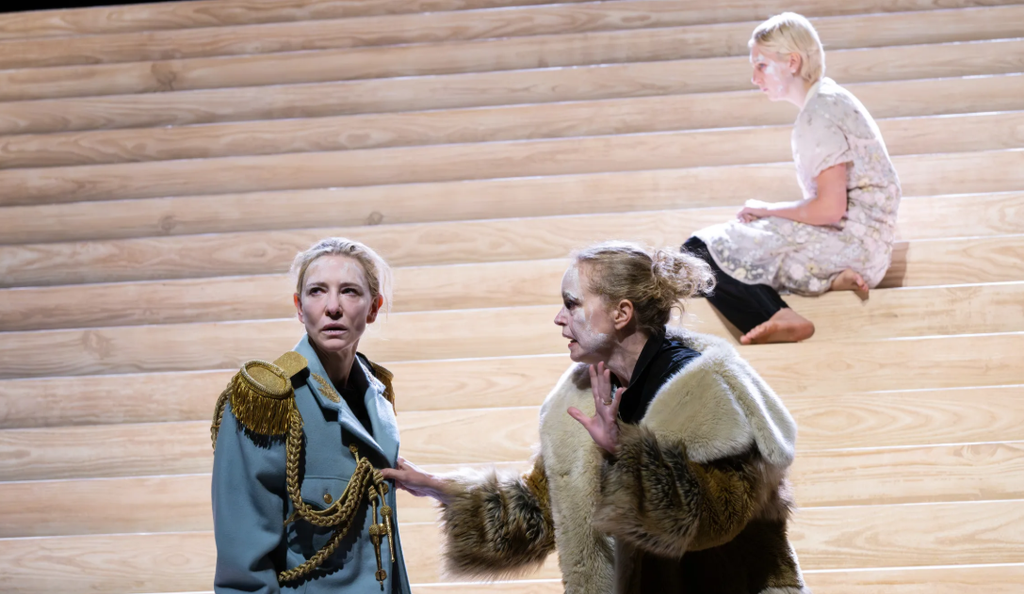
We are led to believe that the toss of a coin determined that we saw Blanchett as Electra. Only seeing the production once, I have no way of assessing what impact that might have had. What I can state very confidently is that the first half, Electra, was off-the-scale good; the second, Persona, was off-the-scale bad.
I cannot be sure, but maybe it would have worked better if the order had been reversed. After the breathtaking intensity of the myth, what followed was unbelievably boring. The filming and semi-pregnant pauses were such a climb-down. The first half went by in a flash; the second seemed to drag on relentlessly.
The ancient plot felt remarkably current, and far more enthralling than the rather un-electrifying 2025 version. I loved watching the mother-daughter dynamic unfold on a set made up entirely of palace stairs. The way the ancient Greek tragedy was modernised felt subtle and considered. Even though the murders and blood sacrifice remain, they come across as analogies for the sort of arguments I have with my own daughter.
The way Blanchett assumes the roles of Agamemnon and Orestes by putting on their respective jackets reminded me of Tilda Swinton in Man to Man, which I had watched the day before. It also echoed the role-swapping and violence of The Maids, where the instability of identity took centre stage.
There are also similarities with Slow Fire, which I saw recently. In both, the re-enactment of past events becomes a way of exploring and coming to terms with trauma. Here, each woman forces the other to act out the murder for which vengeance is sought, occasionally dragging the reluctant Chrysothemis into the performance.
To adapt Bergman’s film, Andrews introduces a screen and a handheld camera, mostly showing Elisabeth in extended silent close-up. I have not seen the film and therefore cannot judge whether this does justice to what I understand is a masterpiece of psychological cinema. What I can say is that, for me, the whole approach sapped all the energy generated by the first half.
I’m sure there are clever parallels between the two pieces beyond the obvious links: the anchoring around a performance of Electra and the repetition of props and lines between them. But whatever those parallels are, they feel too thinly stretched. Or perhaps I was simply so bored out of my wits that my wits stopped functioning altogether.
At least it became clear why there is no interval. If there were, I would recommend everyone leave. Because I would have loved to have left then, before the memory of the first half was overridden by the second.
And that’s what lingers: the frustration of seeing an extraordinary Electra followed by a Persona that never quite justifies its place beside it. That, and the acting masterclass. Cate Blanchett never disappoints, and her sheer technical command and stage presence are unforgettable. Nina Hoss is more than an admirable adversary. Together, the two actresses sustain the experience even when you and the production begin to drift off. Watching them inhabit, exchange and blur the boundaries between actor and character is a privilege.
Leave a Reply