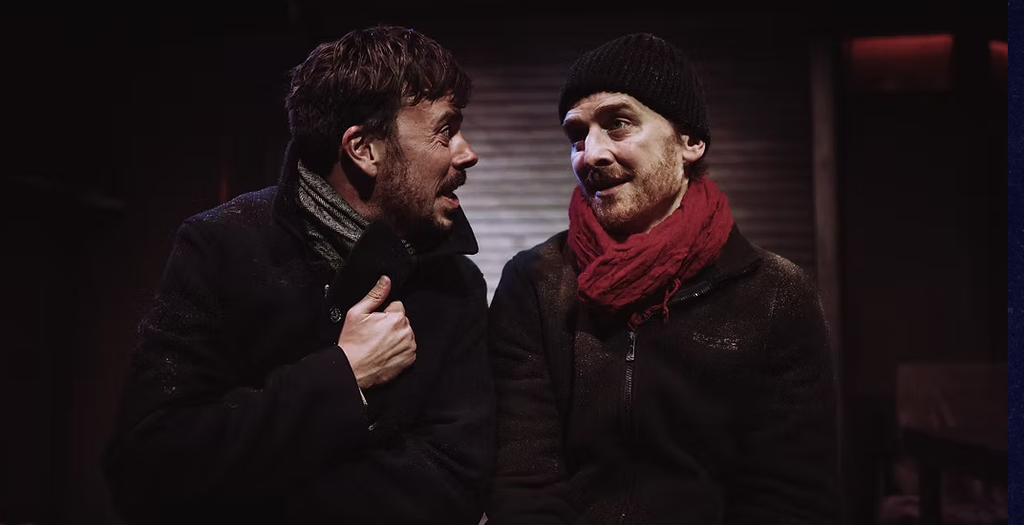
A Slow Fire is a very new play from Simon Stephens (of Vanya fame). It premiered in Dublin in January 2026 and is currently playing at Jermyn Street Theatre in London.
Unlike many dystopian dramas, A Slow Fire keeps the catastrophe largely offstage, a choice that reminded me of I Who Have Never Known Men, albeit with a reversal of the sexes. In both works, the apocalypse matters less than what remains afterwards. The ruined future serves primarily as a backdrop for Ashton and Reece, two men who spend much of the play reconstructing moments from their lives: replaying them, revisiting them and testing them from different angles.
The result often like a form of therapy. Again and again, the characters return to moments that can no longer be changed, particularly those occasions when something important was left unsaid and the opportunity has now passed forever. Because the people they are remembering are dead, memory becomes the only place where those conversations can still occur and where the past can, at least temporarily, be rewritten. Deep down inside, however, they cling on to hope that they may yet be able to have those interactions after all.
Questions of hope recur throughout, particularly whether hope is uniquely human and whether it can survive civilisational collapse. Despite Ashton being a theologian, god occupies surprisingly little space in these debates. Hope is consistently directed towards the possibility of a future rather than any prospect of an afterlife. The play is ultimately more concerned with letting go, coming to terms with change and finding some way forward.
Enter Mary. She appears barefoot from the post-apocalyptic landscape, delivers a litany of everything that has burned and disappears. Ashton never mentions seeing her, suggesting she is some kind of apparition, yet I could never work out what she was supposed to represent or why she was needed to foreshadow the coming of Presley. When he later identifies her as his drowned sister, the scene becomes even less cogent. Mary seems loaded with symbolic significance but serves no clear dramatic purpose. She vanishes and never returns, leaving the episode feeling oddly disconnected from an otherwise grounded play.
I know it is unfair to judge an entire script by a single scene. Yet this one scene disrupted the play’s internal coherence so much that it ended up occupying far more of my attention than it probably should have. That is a shame because the central premise is a strong one. A world reduced to memory. Two men trapped together in a confined space, waiting, talking, repeating routines and searching for meaning. The comparison with Waiting for Godot is difficult to avoid.
There is a recognisably existential quality to the play, with both characters attempting to create meaning after the collapse of the social structures that once defined them. Yet I was left feeling that Stephens ultimately did too little with that premise. By the end, developments that had initially felt compelling had become predictable, and the play never quite realised the potential of its central idea.
Leave a Reply