I read the 1782 novel by Pierre Choderlos de Laclos in high school, relishing the story and its epistolary form. I was engrossed in the act of overhearing secrets and trying to piece together truth from conflicting, unreliable perspectives.
I watched the 1988 film and, even though it had to cut out much of the characters’ internal thoughts, which significantly reduced the depth of nuance, it was nonetheless extremely enjoyable, and the acting was brilliant. Who could ever forget Malkovich’s lascivious smile…
I was therefore looking forward to going to the National to see Les Liaisons Dangereuses with great anticipation, even more so when I learnt that the film I enjoyed so much was actually based on the 1985 Christopher Hampton play. And I was not disappointed.
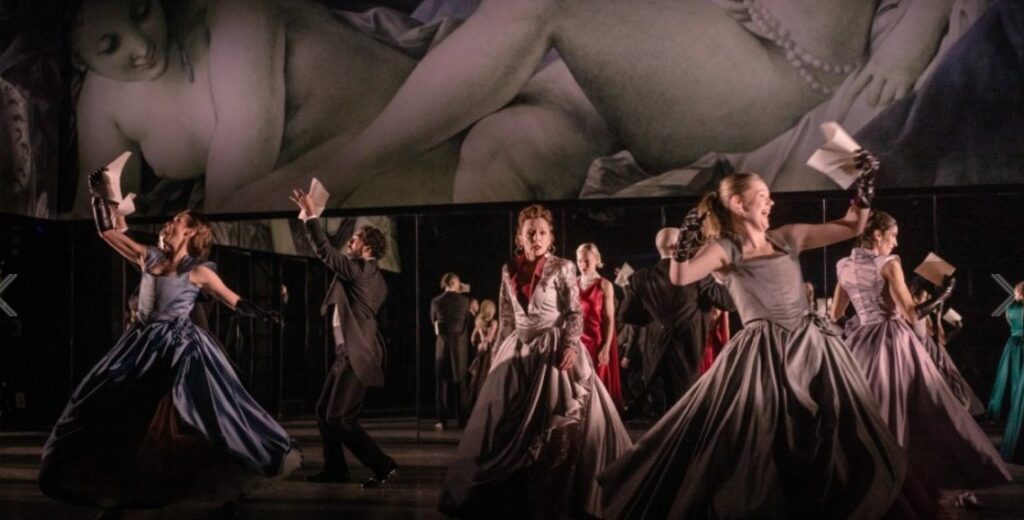
It is an extremely sumptuous production: period costumes in opulent colours, gilding and chandeliers; erotic paintings of young girls surrounding the ceiling; decadent dancers filling the stage with balletic beauty that transforms into aggression, accusation, or intense sexual tension; rooms and houses that swivel and open up, providing a glimpse into what is happening behind closed doors, looked on by voiceless, faceless servants.
And then there are the mirrors, which create a similar sense of voyeurism to that evoked by reading the novel. Although everything seems exposed, it is also reflected through multiple angles — a fractured perspective — allowing the audience to explore the acting and dialogue indirectly whilst, at the same time, never being fully certain the entire picture is, in fact, visible.
The acting is also superb, even if Hannah van der Westhuysen’s Cécile de Volanges is a little too reminiscent of the giggling Selma Blair in Cruel Intentions. But Lesley Manville, as the Marquise de Merteuil, resplendent in a seductive red gown, more than compensates. She is simply breathtaking. No wonder Valmont, played by the 42‑year‑old Aidan Turner, finds her irresistible at 70 years of age — her beauty, elegance, and piercing intellect are a lethal combination.
I am very glad that the production at the National, although apparently based on a slightly refreshed script, did not seek to retrofit the play neatly into a #MeToo morality tale. Because what this story shows is that toxic femininity also exists, and that not all of the world’s woes can be laid at the feet of the men.
Merteuil might explain that her actions are motivated by a need to avenge her own sex, and there is a strong notion that both what she is, and what Cécile becomes, are a direct result of the patriarchal society they have had to navigate (“I already knew that the role I was condemned to…” says the Marquise), and the harm they have suffered from men (the initial sex scene between Valmont and Cécile reads like rape). But at the same time, both they, and Madame de Tourvel, are portrayed with sufficient agency to point out that women are not blameless. In fact, with Turner’s Valmont much less vicious and vile than the character in the book, Merteuil’s statement that “There is nothing a woman enjoys so much as victory over another woman” gains an even more sinister undercurrent.
But the play also illustrates one other aspect of the male–female dynamic that is presently less than popular. In this world, does “no” always mean no, or can it sometimes operate as part of the dance — an invitation to be pursued? The thrill of the chase is hardly a modern invention, and the play does not pretend otherwise. To quote Valmont: “Why do you suppose we… …only feel compelled to chase the ones who run away?”