My husband and I did not buy tickets for Keira Knightley. If anything, we bought them despite her. We went for Robert Icke, whose work we admire enough that his name alone is a reason to book.
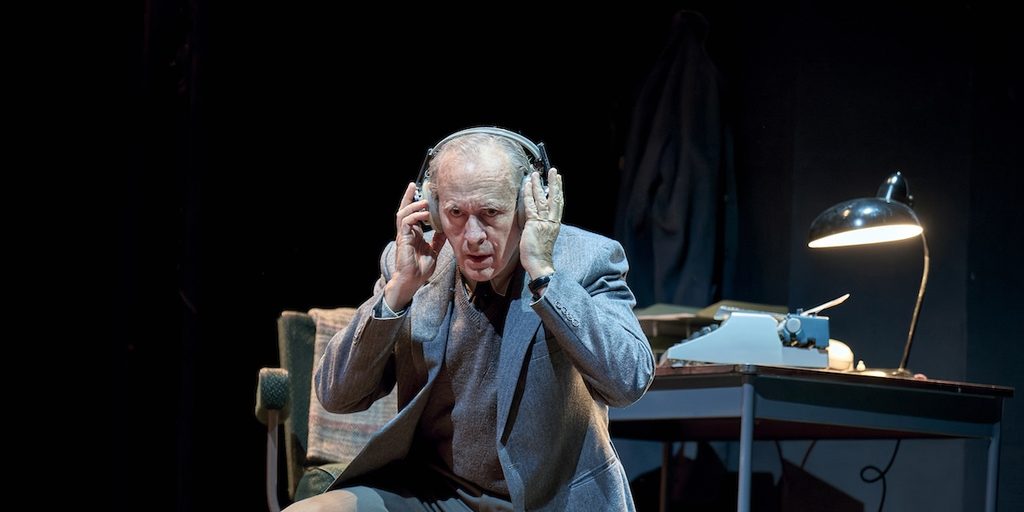
What turned out to be most spectacular about this production, however, was not Robert Icke’s adaptation and direction but Hildegard Bechtler’s stage design. True theatrical magic. The early party scene showed it at its best: the slow rotation of the apartment made me feel like I was one of the guests, moving between the chatting groups. Captain Gerd Wiesler moves among them too, unseen but increasingly intimate with their lives, making the surveillance feel both intrusive and strangely personal. When later on the apartment splits into two, creating a completely different space, I was absolutely in awe.
The revolving apartment also does something rather clever. It allows us, just like the Stasi, to examine the space from every angle. The gauzy inner room remains opaque, creating the semblance of privacy when in fact there is none. Video lets us see what happens inside it, including Christa-Maria taking her pills and her encounter with the minister. The crackle of microphones is equally effective in reminding us that we too are listening in.
But not every theatrical choice works quite as well. The music is occasionally odd, most notably David Bowie in an East Berlin café. The song makes sense in and of itself, but not in the context. And the audio was at times problematic. I could not work out whether it was intentional, a deliberate switching between hearing people in the room and hearing them through the surveillance equipment. If so, it did not quite work. Too often it felt like participating in a Teams call in which other people’s microphones keep cutting out.
As to the story itself, the following day we re-watched the film. On DVD, may I add.
The script matched the subtitles pretty much verbatim. The play is scheduled as two hours; the film is 132 minutes. I could identify a small number of ancillary scenes that had been removed and a couple of sentences and quotes from Romeo and Juliet added. In that sense it reminded me of Guilty: a film transferred to the stage with remarkably little disturbance to the original.
The main adaptation is moving scenes from the various locations in which they take place in the film mainly into the apartment. Some compression of location is obviously a practical necessity on stage, but here it also works. The apartment becomes a place in which the oppressive reality outside seems steadily to close in on the lives being lived within it.
Then there is the very ending, where the film, predominantly told through images, necessarily requires a different solution on stage. I am less convinced by the one Icke chose. Dreyman recounts what has happened, including the final revelation, in a television interview. It has the slightly patronising quality of an unnecessary recap in an American series, dutifully joining the dots in case anyone has failed to keep up. I would rather Icke had trusted us to get there ourselves.
But that is no more than the last ten minutes of the production. Beyond that, the play mirrors the film to such an extent that I was reminded of Wiesler’s interrogation lesson: the two accounts are not merely similar; their very sameness becomes proof of a rehearsed lie. Oddly, the fidelity extends even to the casting. All the main actors seem to have been chosen for their physical resemblance to their counterparts in the film.
The play is nevertheless thought-provoking, not least because the film already gives it so much to think about. The film, maybe more so, because it keeps Wiesler more firmly at the centre of the story than the lives he surveils.
Early on, the minister mocks Dreyman’s plays and their preoccupation with the idea that people can change. People do not really change, he tells him. Yet to a great extent that is precisely what this story is about.
As he becomes absorbed in the lives he is observing, Wiesler becomes increasingly aware of the bottomless loneliness of his own existence. The contrast is made in front of us – Wiesler’s bare apartment against Dreyman’s home, full of art, music, love, friendship and other people. This world of intimacy and human connection makes the barrenness of his own existence increasingly difficult to ignore. The surveillance designed to expose the lives of others instead exposes the emptiness of his own.
And then there is what art does to him. The film additionally shows the impact that reading Brecht has on Wiesler’s metamorphosis; here, the main scene is the moment when he hears Dreyman playing the piano after learning that his director friend has hanged himself. Wiesler curls up and sobs. It is clearly intended as the moment when art reaches somewhere that ideology has not, but oddly it manages to be both too obvious and not quite enough.
The role that art plays in Wiesler’s transformation made me think of The Standard of Living, which I recently saw. And then, from almost the opposite direction, of Good. The two are almost antitheses. In Good, the central character is confronted with the truth of what he is becoming but keeps finding ways to convince himself that he remains a force for good. Wiesler’s journey goes the other way. The more he observes the lives of others, the more impossible it becomes to sustain his belief in the goodness of the GDR and the righteousness of his own role within it.
And perhaps this is where the film, by keeping Wiesler more firmly at its centre, achieves something the play does not quite manage. His transformation has more space to unfold. There is a fascinating inversion of the observer effect in all this. Instead of the act of observation changing the thing being observed, it is the observer who changes. Wiesler sets out to scrutinise the lives of others and is altered by the act of watching them. Surveillance requires him to pay extraordinarily close attention to other human beings and, in doing so, exposes him to everything he has shut out of his own life. He begins as an observer with a malicious purpose and ends unable to pretend that his own life has meaning.
To his credit, even without the space, Stephen Dillane makes that transformation physically visible. The more morally untenable Wiesler’s work becomes, the more depleted he seems. It is a remarkable performance, restrained but utterly convincing.
As to Keira Knightley, she was not as bad as I had feared. In the remarkable early party scene she was actually quite good, floating between the guests with her signature radiant, somewhat false smile. But she does little beyond that and fails to truly show the desperation of her Aponeuron-addicted character.
It is certainly a play worth watching, although I am not sure it adds much to what the film achieves. I was also surprised that, given this is Icke, he did not do more with how relevant its themes feel to the world we are living in now.
There is space here for some rich analogies to what is happening in the world now. One of my memories as a child was of one of my aunts recounting stories of the ‘clicks’ on the phone line. Once, she apparently asked a friend to stop recounting a story as the ‘old fat bloke was surely listening in’. According to the retelling, the surveillance officer cut in and said, ‘Actually I am young and slim, thank you very much.’
Maybe that is why I watch in disbelief how happy people in the UK seem to be to give away their liberties and submit to ever greater official oversight in the name of protection. State oppression is always for our own good, is it not?
The fact that the play sent my mind there is, in itself, an argument in its favour. I just wish Icke had taken it further. I wanted more of the theatrical force he brought to Oedipus and Romeo and Juliet, rather than such fidelity to an already brilliant film.
Which is why, if you have watched the film recently, the play may leave you nonplussed. So don’t watch it as prep. Just go and enjoy the brilliant stagecraft. Then watch the film, which rightly earned Florian Henckel von Donnersmarck the 2007 Oscar for Best Foreign Language Film.
Leave a Reply