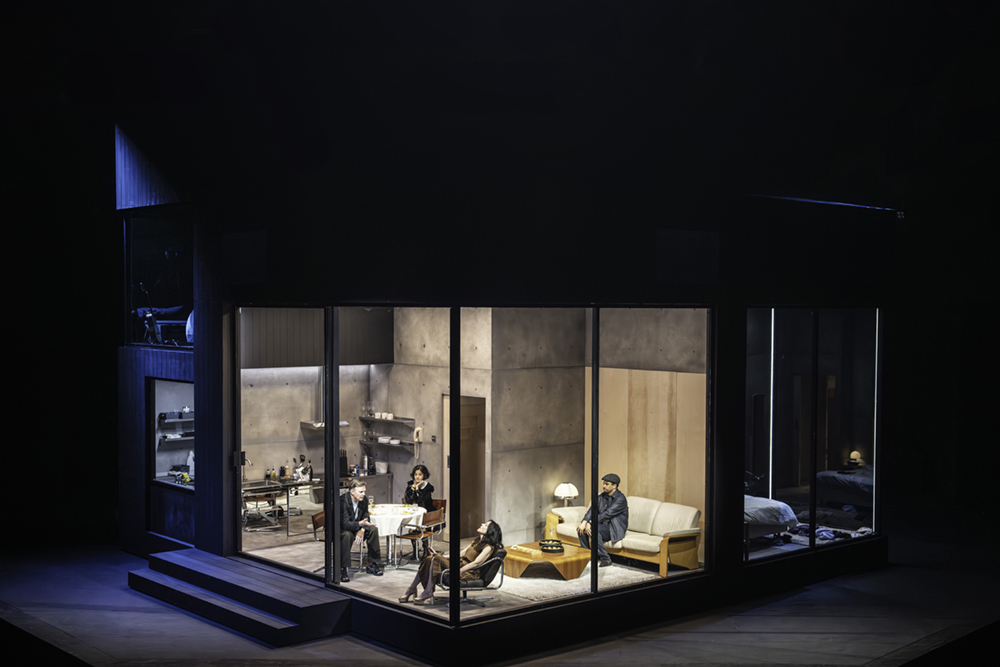
I have no objection to Simon Stone taking liberties with Aeschylus. Any worthwhile adaptation should. And this, according to the publicity materials, is “after Aeschylus and others”. My objection is that he keeps adding to the play while quietly taking away what matters. In the process, the adaptation loses both focus and direction.
The Oresteia is a trilogy of plays that moves from murder, to revenge, to judgement, asking whether private vengeance can ever be transformed into public justice.
- Agamemnon – The Greek commander returns home from Troy only to be murdered by his wife, Clytemnestra, in revenge for his sacrifice of their daughter.
- The Libation Bearers – Orestes returns as a dispossessed son and heir carrying an impossible obligation to, with the help of his sister Electra, avenge his father’s murder.
- The Eumenides – Orestes is pursued by the Furies and put on trial, bringing the cycle of vengeance before the law.
Stone’s play all but removes The Eumenides and in doing so alters the relationship between the private and the public that gives the original trilogy its force. The Oresteia is not simply a story about revenge. It is a story about what must replace revenge for society to function.
In Aeschylus, the crimes of one family eventually require society itself to intervene. Here, society’s problems already exist independently in the form of war, arms dealing and corporate misconduct. They are neither caused by the family tragedy nor resolved by it. The connection between the private and the public is therefore lost.
Stone also changes the moral position of Orestes by making Augie appear compromised long before the matricide. Sent away by Montie under a cloud of suspicion for some unspecified wrongdoing, he is stained in advance. By the time he kills Montie, the act feels less driven by duty to his father and more by personal resentment and rejection.
That shift matters because it alters not only the motive for the murders but their moral significance. In Aeschylus, Orestes commits an appalling act under the weight of an impossible obligation. Every available course of action is wrong. To avenge his father, he must kill his mother; to spare his mother, he must betray his father. Aeschylus recognises that such conflicts leave deep wounds, but suffering does not exonerate. He asks how a society can move beyond revenge when every act of revenge has a prior wound as its source. His answer is law: imperfect, contested, but public.
Stone instead replaces accountability with psychological collapse. Augie is not judged because he is unwell and the murders are treated as symptoms of that condition. Mental illness, trauma and neurodiversity may explain behaviour, but explanation is not the same as absolution. Aeschylus understood that. Stone seems less certain.
There is also a strange inconsistency in the adaptation’s supposed modernity. At a moment when writers such as Costanza Casati have found new complexity in the figure of Clytemnestra, Stone’s version of turning her into an utter villain feels oddly regressive in conception, a problem exacerbated by the weakening of the Isabel/Iphigenia parallel. In Aeschylus, the sacrifice of Iphigenia is devastating because it is direct. Agamemnon chooses to kill his daughter so the Greek fleet can sail. That act gives Clytemnestra’s rage its terrible legitimacy. Stone’s modern equivalent is much less powerful. The idea that Christopher “sacrificed” Isabel to the media in order to protect his business may be ugly and selfish, but it falls far short of actual culpability. Stone would have been better off leaving the audience to fill in the gaps of what actually happened to Isabel.
This structural muddle is compounded by the amount of extra material Stone adds. Aeschylus builds his drama through a relentless chain of cause and consequence. It is also written as three separate plays, allowing the audience time to absorb each stage of the tragedy. Compressing that into one long play requires discipline and a clear sense of what the adaptation is really about. Instead of stripping the original back to its essential tragic line, Stone keeps adding new strands that weigh the production down with subplots that never acquire significance.
Lorenzo, who has no clear equivalent in Aeschylus, is a prime example. His hostility towards his father introduces an additional conflict, whilst his sexual relationship with Augie and engagement to Letitia have no bearing on the trajectory of the tragedy. The result is not greater depth but a loss of focus. The same problem applies to Mel’s divorce. Helen’s absconding with Paris to Troy is the catalyst for everything that follows. Here, the divorce has no meaningful impact on the story and should therefore have been omitted.
That problem is compounded by the writing and direction: too much shouting, too much swearing, too much overlapping speech. What is already difficult to follow is additionally obscured by the glass-box staging. The voices often feel trapped inside the structure, producing a muddied, echoing effect.
Much has been made of this glass-box design and its supposedly voyeuristic quality, but theatre is voyeuristic at its very core: the audience sits in the dark watching people expose private lives on stage. Enclosing the action in glass merely literalises the concept and becomes a barrier between the audience and the drama. I had central seats in Row F and for much of the play the frame and beams were physically obstructing the actors’ faces.
And the device is not even fresh. Although The Oresteia is designed by Lizzie Clachan and Stone’s Phaedra was designed by Chloe Lamford, the trick is essentially the same: another modern classic, another household, another rotating glass box through which we are invited to observe yet another family destroying itself where the woman is reduced to a villain.
In the end, more proves to be less. Or perhaps more accurately, more proves to be less moral. I walked out of the theatre feeling as though I had watched a Netflix limited series and, as with most Netflix series, found myself utterly emotionally unaffected, even though what little of the acting I was able to see and hear through the glass and beams was superb.