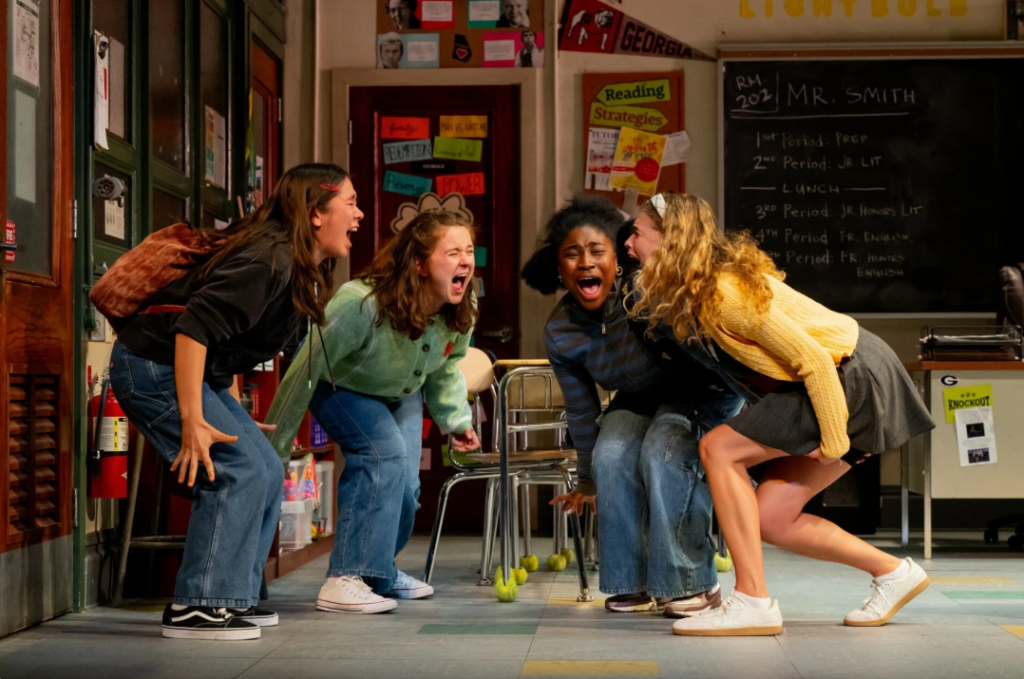
We went to see this play as a family, very early on in its run, and had the fortune to follow it up with a Q&A session with the playwright herself. It was a superb experience, and the close setting of the Royal Court added to the feeling of being part of something quite unique. What a pity, then, that this is such a limited run in such a small venue; whilst I loved the immediacy of the space, the combination means far fewer people will have the chance to see this production. And that is unfortunate, because every mother should take her teenage daughter to see this; every school should go and see it too – if only for the conversations it can open up. That is what theatre is great for, after all. As I was tucking my daughter into bed that night she said, “Do not worry, Mama, if any teacher is funny with me that way, I will tell you straight away.”
But let’s start by getting one thing straight – I am not convinced that John Proctor is the villain.
Recently, my daughter played Abigail in a short scene extract at her drama lessons. She did a brilliant job displaying the duplicity and agency of the character. It would be quite reductive to absolve the girl of any responsibility and blame the men around her for all that transpires. I find these sorts of overly feminist narratives somewhat infantilising.
That, however, does not take away from the painful truth about the world we inhabit. Despite #MeToo, all the DEI agendas, and tokenistic International Women’s Days, systems keep failing women and girls, over and over and over. Mandelsons continue to be appointed ambassadors.
On the other hand, my son played John Proctor in his secondary school production – he would come home after rehearsals talking about how uncomfortable he felt shouting “whore” at female cast members who were his junior. He may have been superb at getting into character, but he most certainly did not relish that part of the role.
Because my son is already very different to the boys I knew when I was his age and very different to the men who objectified me when I was starting out my career at Andersen’s. Things have changed, although this play painfully highlights that they have not changed enough. The darker message takes a moment to settle. The production is full of energy and colour and the humour and laughter come thick and fast. It is easy to be swept along by all that brightness, especially because of how naturally you fall in love with the friendships between the girls and the joy of watching them at such a precarious time in their lives.
That feeling comes partly from the writing and the way the production holds those relationships, but it is also shaped by the chemistry within the ensemble that is filled with tenderness and sincerity.
Because this young company is in fact exceptionally good and believable, with some superb debuts. Molly McFadden played the part of the counsellor with breathtaking subtlety, but I cannot help feeling that visually illustrating how difficult it can be for women to oppose men would have strengthened the impact and created an arc back to the “rape kiss” in the earlier scene. McFadden is a similar height to Mr Smith and roughly twice his bulk. This makes her action in the ending scene, when she places her body between this predatory man and the girls, feel less heroic than it could have. On average, women are of a much slighter posture than men, and it is that physical disparity that contributes so much to how difficult it is for us to stand up and oppose them. This is probably why Sadie Soverall, with her tiny waif of a frame, worked so well, and why Shelby’s defiance came across so powerfully.
Even though the predator remains in the classroom, there is real power in the closing scene — the dance that is both a protest and an expression of support. There is no judgement about who joins in and who does not; not everyone can, not everyone feels they have a right to. And that is fine. But we cannot all remain seated forever, so let’s dance.
Let’s dance, because we can. Let’s dance and celebrate our freedom. Let’s dance in celebration of the friendships that sustain us. Let’s dance in defiance of the systems that continue to fail us. Let’s dance in opposition to the politicians who, with one side of their face, claim protecting us is their top priority, and with the other, sell our safety and dignity down the river of expediency. Let’s dance in solidarity with those women who are not allowed to join in with us. And let’s dance not to forget that, if we are not vigilant, men will take our rights away. And let’s dance not to forget that there will be women who help them do that.