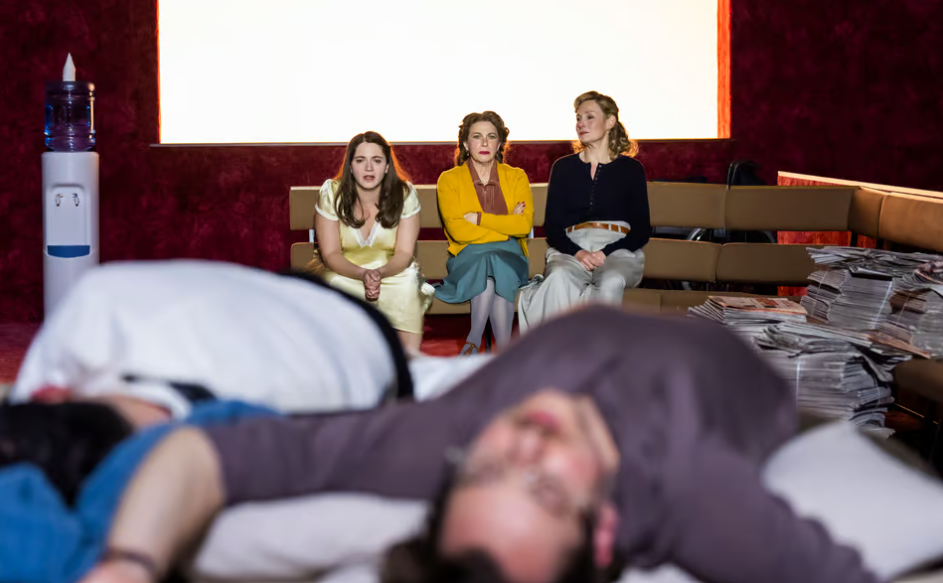
Broken Glass premiered in 1994 — first in New York, where it was mostly disliked, and then in London at the National’s Lyttelton, where the reaction was more mixed. It became one of Miller’s more criticised works, with many seeing it as a messy low in his career. But wanting the play to resolve itself neatly misses the point, because, as the title implies, life is fractures: Kristallnacht’s smashed windows; the crockery of a wrecked marriage; the Jewish wedding glass; the cracked mirror no one can fully trust. Everyone in the play mis-sees each other — and themselves.
Miller wrote this in his seventies, and you can feel him looking backwards. He told David Thacker that it came from watching the international community freeze during ethnic cleansing in Bosnia; but basing the doctor on Marilyn Monroe’s physician adds another dimension. Miller is circling his own marriage. His own failures. The people he couldn’t save. For all his authority, he couldn’t change the world.
For me, the play isn’t simply about silence or inaction; it is about impotence in the broadest sense. Even those who want to act can’t — and, if we’re honest, we are just as often caught in that same stasis. Sylvia’s paralysis becomes the physical expression of that, and the casting of actors visibly younger than their characters underlines how we don’t age in our own minds. We go on believing there’s still time to fix what’s broken, to act differently, to choose better — only to realise, too late, that we failed to act.
And that sense of powerlessness runs straight into what Miller sees so clearly about women: the way our agency is constrained not dramatically but domestically, almost invisibly. Miller is a male playwright with an uncanny understanding of women and our plight — not in a sentimental register, but in the way he writes our private disappointments, and in the way he captures male desire, how it can tilt so easily into violence or impotence. The desire directed at Sylvia here echoes the dynamic around Ann Deever in All My Sons.
All of this is underscored by the staging, which feels almost womb-like: a narrow red carpeted strip running through the audience. Even Dr Harry Hyman’s name feels pointed — a Freud devotee who has spent his life thinking about hymens.
Once you see it that way, Sylvia’s transformation becomes inevitable as she begins to face up to the reality that she’s wasted her past. She finally sees Philip for what he is – a domestic tyrant who buys pickles as a gesture of affection and slams them down in a flash of violence; a man whose own experiences of antisemitism have curdled into a quiet, habitual misogyny he redirects towards the women around him. Abuse isn’t always theatrical. It can be quiet, everyday, so woven into the fabric of a marriage that it starts to look like normal life. How often does it go unnoticed? How often is it something dark but hard to name?
Her frustration with her self-hating, impotent husband — desperate to assimilate while ignoring antisemitism both abroad and in his own home — hardens into clarity. “A whole life,” she says. “Gave it away like a couple of pennies — I took better care of my shoes.” It carries the same overwhelming futility Linda Loman feels at Willy’s graveside.
Sylvia;s claim that she remembers no lovemaking for twenty years — that Phillip may have invented the memory entirely — becomes increasingly plausible. She recognises her inability to steer her life. The Jews in Germany who stayed — who scrubbed streets with toothbrushes because they still believed it was safer not to leave — at least had a reason for their paralysis. But what’s Sylvia’s reason for staying in a relationship devoid of warmth or intimacy? At moments the play becomes a quiet defence of women who step outside their marriages after being abandoned — emotionally, physically — by men too weak to inhabit the full space a partner should hold.
Listening to Sylvia cry out, “Where is Roosevelt? Where is England?!?” — an accusation more than an appeal — felt exceptionally surreal in the context of Donald Trump announcing that Starmer is “no Churchill.” What should have been a historical outburst felt unnervingly present. Keir Starmer’s response to the 2026 Iran conflict displays the same choreography of restraint; but what is the cost of holding back, and how easily will caution be reframed as weakness?
For much of the evening the houselights stay up, the audience fully visible, with nowhere to hide. Just like the goldfish on stage, circling its bowl. Round and round. History repeating itself: Iraq, Bosnia, Iran. Same bowl. Same difference.