I am not entirely sure why Arcadia has acquired a reputation for being overly intellectual, whilst Copenhagen has not. The former gently ranges over a variety of broadly shared humanist reference points; the latter feels like being sat down for a lesson in nuclear physics, with a rather heavy‑handed allusion to Heisenberg’s uncertainty principle.
At the Old Vic, I remember laughing with the audience. At Hampstead Theatre, I found myself oddly self‑conscious about laughing, either because no one else did, or because they joined in after a noticeable delay. Not that it particularly matters. I know enough to follow the story without feeling like my brain is being actively tested. But that depth of nuclear exploration felt neither here nor there in relation to the story being told. It began to feel less like texture and more like insistence. As a result, the whole thing came across as faintly conceited.
Nonetheless, I do like the premise. It has something of a video‑game logic to it: try something, see how it plays out, then reset and try again. Explore the options; examine the consequences. The first half is built around that idea, and it is genuinely engaging. There is a lightness to it, even a playfulness, as the characters circle the same moment from different angles. The second half loses that element and becomes somewhat tedious, lacking the earlier sense of experimentation.
All of that aside, I have real problems with the intellectual cohesion of the piece. The play dwells on a single meeting and its implications — what, precisely, did Bohr and Heisenberg discuss when the German physicist visited his former mentor in occupied Copenhagen in 1941 — but it does so in full knowledge of what Bockscar and Enola Gay would later accomplish.
Applying hindsight to the exploration is not, in itself, a problem—but it requires a certain intellectual discipline. The play never quite decides whether it wants to inhabit the uncertainty of that moment as it was lived, or interrogate it with the knowledge of what came later. Instead, it slides between the two. The result is an argument that feels oddly untethered: decisions made in 1941 are judged with an awareness of outcomes that the characters are simultaneously allowed to know and not know, depending on what the moment requires.
This is where it starts to fall apart for me. At the end of the day, we are talking about physicists — men who deal in numbers. The atomic bombs dropped on Japan are generally estimated to have resulted in around 200,000 deaths. That is also the approximate number of Romani people murdered by the Nazis. My own Polish people lost around 1.8 million in concentration camps. Over six million Jews were annihilated in the Holocaust. My point is not to weigh one catastrophe against another, but to note that once hindsight is brought into the room, it cannot be used selectively. If the play allows its characters to know where history ended up, then that knowledge has to be handled with intellectual consistency, rather than appearing only when it helps the story along.
Because Heisenberg seemingly combines a genuine love of his country, with a lack of knowledge of the worst of the atrocities it committed. The problem is not that the play acknowledges this complexity, but that it never quite settles on the terms under which it is judging him. The footing keeps shifting. What sort of hindsight is this—15/15?
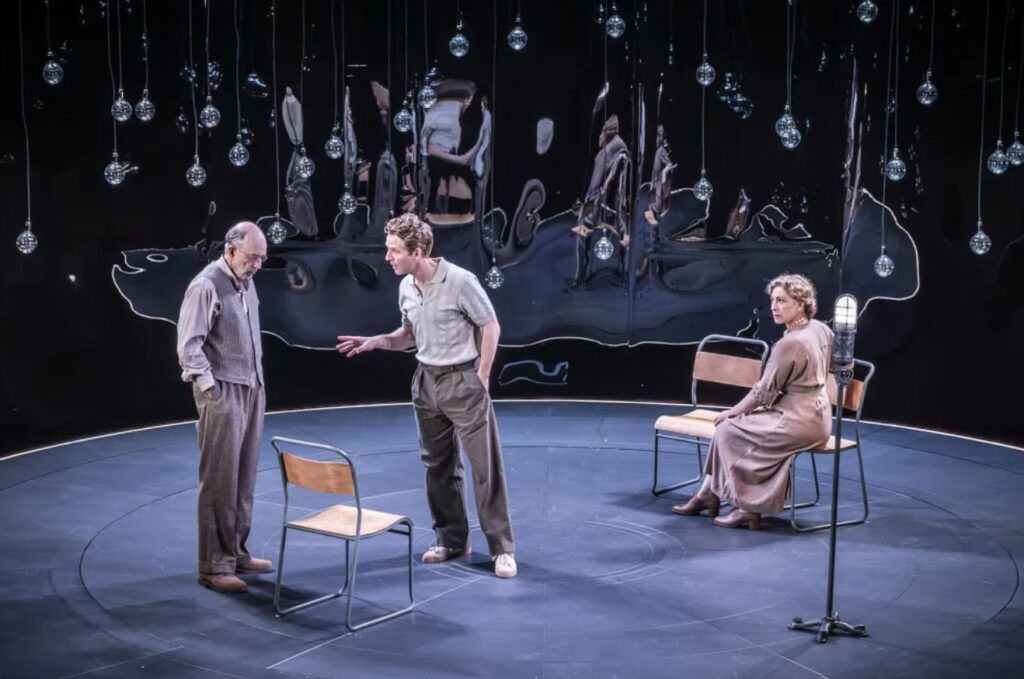
All that said, the acting was nothing short of spectacular, and it almost felt immersive. I had the sense of eavesdropping on two physicists—one still fully in command of his faculties, the other on the way down, slowly losing his grasp on his own genius and increasingly relying on his wife to make the connections. Alex Kingston is superb as Margrethe, bringing a grounded, often mocking realism to the men’s endless exchange. She frequently occupies the centre of the space, both physically and intellectually, and it is through her that the play feels most sincere. At times I felt like I wanted to go for a drink with her and commiserate about the general uselessness of men (or husbands).
The staging, too, was superb. Joanna Scotcher’s set is a revolving black disc of a stage, clearly resembling an atom, surrounded by black water, like the heavy water in a nuclear reactor. Pulsing lights hang from the ceiling, reflected in the surrounding mirrors. I am not entirely convinced what the subplot about the child lost at sea was meant to add, but when the water—whose presence I had not even clocked—began to stir and the fog began to rise, it was breathtaking.
For me, Copenhagen is one piece in a much larger jigsaw: Oppenheimer on one side and Operation Epsilon on the other. And I must say that Operation Epsilon may not have been as lauded as Copenhagen, but it raised many of the same questions with considerably more grace and far less preconceived judgement. And it most certainly did not feel like a GCSE tutoring experience.