I went to see Man to Man for the opportunity to watch Tilda Swinton perform live, with no prior knowledge of the play. Contrary to the reviews I read afterwards, I do not consider gender its central concern. In my view, sex functions principally as a vehicle through which Karge explores a broader theme: the need to mask one’s true self in order to survive.
Although Ella’s assumption of a male identity is fundamental to the plot, she does not come to believe she is Max. Rather, her survival depends on passing as a man, just as Solomon Perel’s survival in Europa Europa depends on passing as an Aryan German and a member of the Hitler Youth. The tension derives both from the constant possibility of the disguise being exposed – Ella’s lack of a penis and Perel’s circumcision are permanent physical markers that could out them at any moment – and from the moral dilemmas created by role-playing.
In Europa Europa, the deception remains credible because Perel’s survival depends upon it. The same is true at first in Man to Man, where Ella assumes her dead husband’s identity to keep his job and avoid destitution. As the years pass, however, that justification evaporates, and the play offers no convincing explanation for the continued masquerade. The result is that its central conceit loses dramatic credibility.
Other aspects of the script are less than fully convincing too. In the early scenes, there is a considerable amount of detail whose significance was not always clear to me and therefore felt like it dragged somewhat. That may simply reflect my lack of the cultural and historical context needed to appreciate references that could potentially resonate with a German audience. Yet after lingering over the period from the 1930s to the 1950s, the narrative suddenly hurtled forward at warp speed through post-war Germany, the division of the country, the fall of the Berlin Wall and the resurgence of fascistic political sentiment.
The result is a strangely unbalanced work. By the end, the play seems more interested in touching a series of predetermined historical landmarks than exploring their significance. None is developed sufficiently to carry dramatic weight, and they ultimately feel unnecessarily appended. Just as it becomes increasingly difficult to understand why these events have been introduced at all, it becomes increasingly difficult to understand why Ella continues to present as a man.
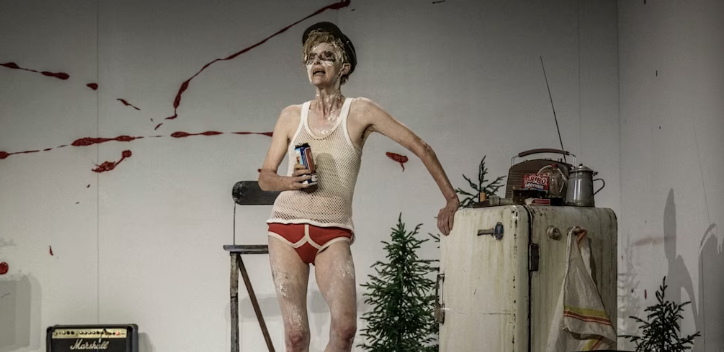
But even when the plot loses the plot, Tilda Swinton never loses a beat. If I did not find the play captivating, her performance certainly was. For ninety minutes she is shambling, vulgar, funny, bitter, defiant and, beneath it all, profoundly lonely Max. There is an extraordinary physicality to the performance. Every movement of the eyes, gesture and shift in posture is captivating. She plays a convincing man, but you can always see the actual woman she is. Bizarrely, it is in the scene where Max dresses up as a woman, complete with wig and lipstick, that Swinton looks most like a man in drag.
This is where Swinton succeeds where the script struggles. She makes it plausible that, after decades spent surviving through performance, Ella can no longer simply step out of the role. The years of concealment and the relentless effort required simply to survive have fractured her sense of self. Although the female “Snow White” persona is still there, life as Max has become Ella’s default mode of existence, not a choice. Swinton’s performance supplies a psychological logic that the script never adequately develops, restoring a degree of credibility to a plot that Karge’s writing increasingly struggles to justify.
The production is helped enormously by Bunny Christie’s staging. The stage appears littered with the accumulated debris of a lifetime: furniture, appliances, chairs, cans, a television and countless other objects scattered across the space. Ella’s past is present throughout and, like the discarded fragments of “Snow White”, it lingers at the edges of the stage, waiting to resurface. Yet much of it goes unnoticed until the moment Swinton reaches for it, from forgotten household objects to the strip of red tape running down the centre of the stage that represents the Berlin Wall and which she eventually tears up to mark its fall. The result is a set that reinforces that the person Ella once was has not disappeared, but lies buried beneath the accumulated layers of performance that defined her life.
Leave a Reply