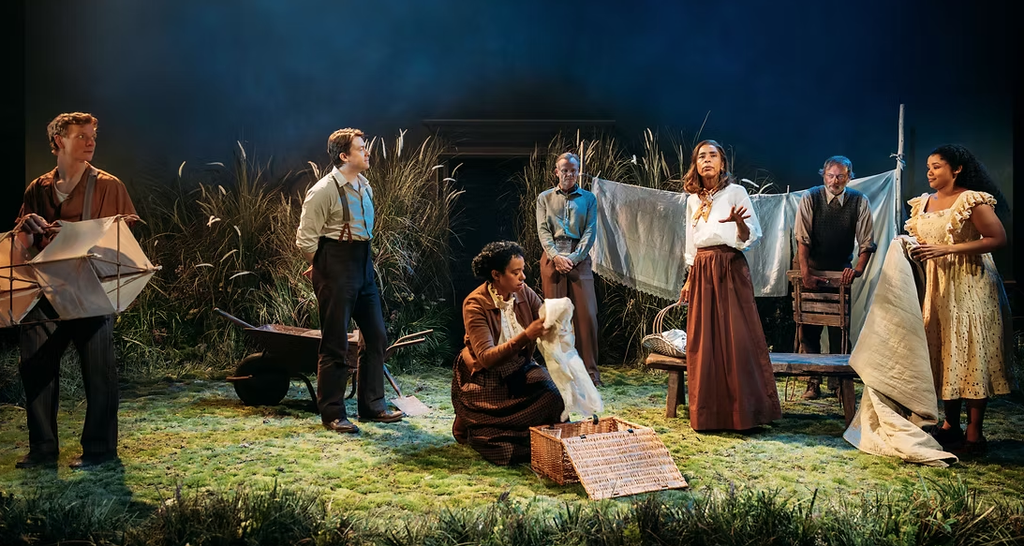
This was the third Russian play I’d seen in fairly quick succession, after The Seagull and Summerfolk. In A Month in the Country, disappointment is expressed primarily through romantic desire, though beneath the love plot lies a broader unease about aging, inertia and lives insufficiently lived. Chekhov deepens these concerns, showing how artistic ambition, love and personal fulfilment become entangled. Gorky’s Summerfolk extends the focus outward, treating private dissatisfaction as a symptom of a wider social and political failure.
But there is a common thread, or perhaps a common feeling, running through all three, reinforced by imagery that recalls Nikita Mikhalkov’s Burnt by the Sun: long grass, reeds, summer warmth, dappled sunlight. There is something about the Russian imagination that associates the countryside with endless summer abundance, idle conversations and unrequited love, where everyone appears to have enough and yet nobody is truly happy.
Leslie Travers places the action in such a setting, with the household furniture moved outdoors among tall reeds, opening out into the world. However, before the action begins, and during scene changes, the space is enclosed within a box, a visual reminder that for all the appearance of openness, the characters are ultimately imprisoned by social convention, circumstance and their own desires.
Russian male playwrights seem fascinated by women whose emotional restlessness unsettles otherwise stable worlds. The men frequently moon about, philosophise or passively endure events. The women actually do things. They fall in love, pursue, scheme and manipulate. Yet they rarely seem to emerge happy for their efforts. Natalya Petrovna is no exception.
Admired, almost venerated by those around her, doted on by her husband and leading a comfortable life, Natalya is agitated and bored. She toys endlessly with Michel, keeping him around as a devoted lapdog while never really giving him anything in return; she mistakes physical attraction to a young tutor for love; she becomes consumed by jealousy of her 17 year-old ward Vera. She swings rapidly between affection, insecurity, manipulation and self-pity.
I can understand this behaviour from a bored woman of twenty-nine. Having it performed by someone approaching sixty was incongruent. That isn’t a criticism of Sophie Okonedo’s performance. Quite the contrary, she was brilliant: funny, quick, filling the dialogue with nervous energy, depth and nuance. It is more a question of whether casting an actress with this much gravitas ultimately serves the character.
On the other hand, the choice of Alistair Petrie as the downtrodden Michael worked very well. He plays him with a kind of weary patience that brings out both comedy and sadness in the predicament he finds himself in. His is probably the character who undergoes the greatest change, as self-realisation comes to the fore and he finally understands that he must will himself to move on.
Overall, however, the production leans heavily into comedy and Brian Friel’s adaptation remains wonderfully conversational. The dialogue is witty, natural and often very funny. Mark Hadfield’s Herr Schaaf repeatedly gets laughs through his misuse of language; Daniel Rigby’s doctor delivers the most dreadful ‘doctor, doctor’ jokes; the secondary romantic entanglements are a source of great mirth.
But some of the extended monologues and broadcast-style expressions of inner thought felt unnecessary. At times I felt slightly patronised, as though the production did not trust me to work out what the characters were feeling for myself. I do not need Natalya to explain her emotions in detail; I would rather be left alone to interpret them.
What I see is a portrait of a woman trapped as much by circumstance as by her own emotions. These women in Russian dacha dramas are, of course, constrained by the social expectations of their age. Marriage determines almost everything. Independence is limited. The horizons of their lives are narrow. I struggle to imagine existing within such a prison, condemned to the same routines and conversations, my brain sentenced to withering away. You can hardly blame them for scheming, flirting and dreaming of affairs. There was precious little else to occupy their minds.
My days are filled in ways that would have been unimaginable to Natalya. Yet nothing in Turgenev’s portrayal suggests she is any less intelligent than a modern professional woman. The difference is that I have the pleasure of work that is intellectually demanding, stimulating and often exhilarating. There is always another problem to solve, another task to complete, another conversation to have, another idea to test.
Yet I still found myself wondering whether modern life has simply exchanged one kind of confinement for another. Natalya’s world was shaped by the expectations of nineteenth-century society. Marriage was her purpose and her destiny. The boundaries were obvious.
Natalya’s prison was built from restrictions. Ours is built from expectations. Today’s woman is expected to have a successful career, be a devoted mother and partner, and make it all look effortless. Put family ahead of work and you’ve sold yourself short. Don’t have children and you’re missing out on womanhood. Accept help and you’re weak; do everything yourself and you’ll eventually break. Our choices are undoubtedly broader than Natalya’s. But does having more options necessarily make people happier?
Watching the third collection of beautiful, privileged people drifting around a sun-drenched estate while making themselves thoroughly miserable was not entirely unlike the conversations I have with friends, and indeed myself, about the challenge of reconciling career, motherhood and the competing demands of contemporary life. The circumstances are entirely different, but the tensions between conflicting desires are not. Turgenev offers no catharsis. What lingers instead is the suspicion that the struggle to find purpose and contentment transcends every social arrangement, whether in nineteenth-century Russia or twenty-first-century London.
Leave a Reply