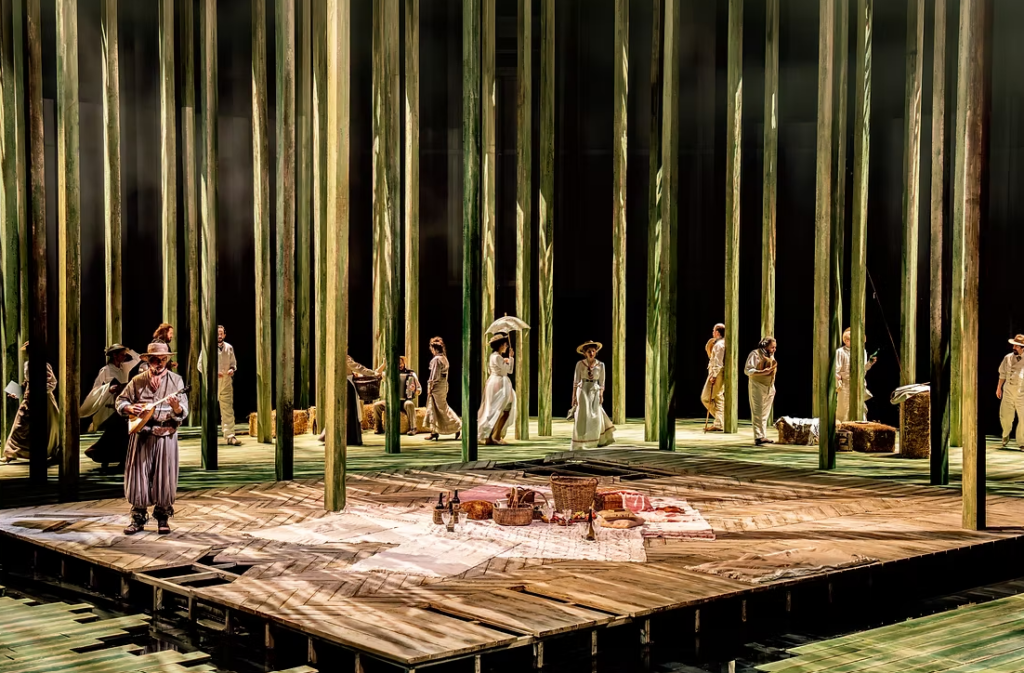
I like a lot of Russian classics – books, plays. There is so much lyricism in Master and Margarita, and so much longing in The Three Sisters. So I was quite excited reading on Wikipedia that Summerfolk is a play by Maxim Gorky written in 1904 (…) full of characters who “…might have stepped out of a Chekhovian world.”
I was still somewhat apprehensive — and will always be — after the Anya Reiss Seagull rendition. But as soon as the play started, amidst beautiful scenery and gorgeous period costumes, I felt myself relax. The wooden pillars extending into the sky drew my gaze instantly and instilled a sense of calm. I was ready for some Russia in the summer of 1905, where dachas have replaced orchards and the nouveau riche middle class lounges about and wastes the days away on idle, champagne-soaked conversation.
That calm lasted until the characters began to speak. I didn’t mind the updated language — with so much dialogue, contemporary phrasing does make it easier to absorb. But the swearing and overt sexual references (“it’s good to be alone when you’re young – the wanking years”) really jarred and were completely unnecessary. It simply clashes with the period so sharply that it pulls you out of the world the production is working hard to create.
What was necessary on the other hand, was cutting this play down even more. I understand that this adaptation by Nina and Moses Raine is around 45 minutes shorter than the previous staging at the National. But there is just not enough to the plots and issues and crises. I felt that cutting one or two subplots and reducing the cast down to below twenty would have helped. Because there is a natural limit to how long one can focus on elegantly staged inaction.
It’s hardly surprising I started to feel like the only sober guest at a party while everyone else drinks — the conversations circling the same few points, growing louder and more emotional without gaining meaning. Three hours of that wears thin and awareness dawns that half the room has outstayed its welcome. And it isn’t simply a matter of attention span – but the fact of the matter is that this is a play about inaction, and there is only so much waiting in vain for something meaningful to happen that one can truly enjoy.
Still, something lingered. What struck me most was how familiar these conversations felt — the empty philosophising, the way tiny problems are dramatised into life crises, the hollow debates about purpose, the small worries swelling into impossible obstacles, the exaggerated self‑importance floating above it all with nothing underneath to hold it up. It’s a familiar kind of hollowness: good‑time ‘summerfolk’ convinced that a single social‑media post is evidence of a moral stance.
Which made me wonder about the performances. The acting often felt like quite flat delivery – but maybe that was the point: all of these people permanently acting, nothing about their lives actually real — it is all pretence and form. It’s a clever notion, but three hours is a long time to sustain a metaphor.