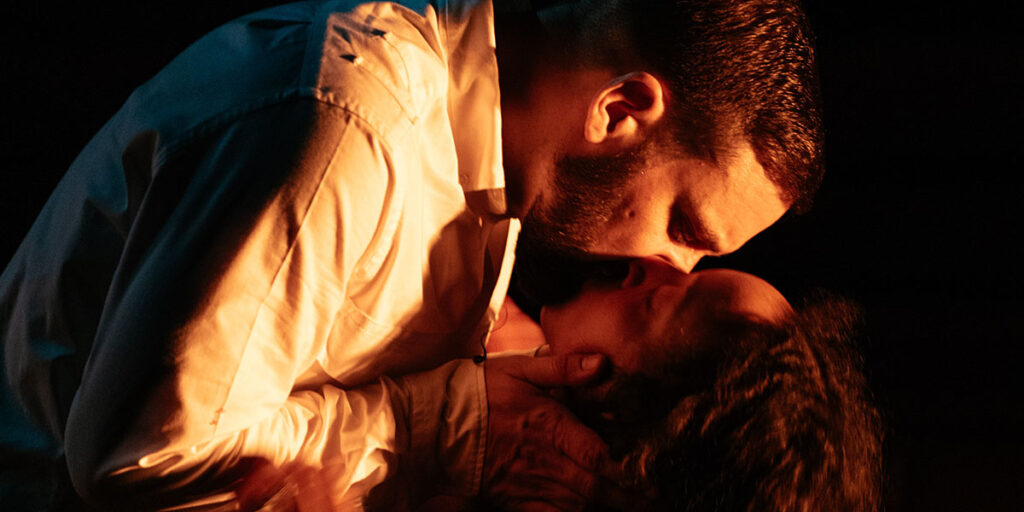
The Young Vic is generally known as the edgier, younger sibling—home to innovative productions of both classics and new writing. It follows that anything staged in the smaller spaces (The Maria, 150 seats; The Clare, 70 seats) may err on the less polished side.
But this felt like rough-around-the-edges taken to a new level. The only genuinely positive aspect of going to see this performance was that, for the first time, we ate at The Cut restaurant—and it was excellent. Things went downhill fast after the burnt aubergine with cashew labneh.
First, the acting. This was hardly superb. Adelle Leonce as Ash was particularly perplexing. I struggled to understand the choice of having her arrive for her first day at work still drunk and immediately antagonistic towards her boss. Not that I have personal experience, but her abrasiveness and arrogance felt at odds with the notion of Battered Woman Syndrome. Dom, meanwhile, comes across as one-dimensional—perhaps convincing as a thug, but revealed as such far too early, with little ambiguity in either writing or performance. The depiction of coercive control and domestic violence is, of course, painful, but offers little that feels new—hardly A Streetcar Named Desire. Lily, the archivist, is probably the most nuanced of the three.
Then the staging. The traverse setup did not seem to take the audience into account. Configured as an oblong, with unreserved seating along the two longer sides, around 75% of the action took place at one of the shorter ends. We were seated near the opposite side, where perhaps 20% of the play occurred. By the end of the 90-minute, no-interval performance, my neck was in agony. The woman next to me gave up halfway through and simply stared into the empty space in front of her. There was, however, one effective moment: the archive catching fire, where the combined use of light, smoke and sound made it feel genuinely frightening.
And then there is the script, with its many holes and bizarre constructs—at times it was hard not to laugh. An important archive, yet with no security: anyone can wander in, remove files (as Dom does), or bring in prohibited items such as candles. It is very convenient that the archivist keeps a spare dress in a desk drawer; equally convenient that this supposedly controlled environment includes a shower. The radio switching on and off might be intended to build dread, but without that atmosphere being established, it simply feels odd. There are hints of lesbian attraction, references to being brought up in a cult, a rabbit, a miscarriage—you name it, you got it.
There are also too many strands introduced and left unresolved. The witchcraft connection initially intrigues, but ultimately loses relevance. The suggested parallels between 17th-century misogyny and today—and between historical and contemporary justice systems—are insufficiently developed. Then there is the suggestion that Dom may not be a police officer, or may not have a daughter. The bee motif runs throughout: the title, the pond anecdote, the trapped bee, and finally the swarm that the protagonist seemingly controls through witchcraft. It must be witchcraft—because otherwise how does Ash fill the flat with bees? Yet that, in itself, undermines the play’s central premise about women being unjustly persecuted for witchcraft.
Swithinbank needs more practice to turn a collection of ideas into a coherent piece. I would also suggest dining at The Cut—if only to appreciate how fewer, more carefully chosen ingredients can make for a far better meal.
One response to “Making a meal of it”
[…] is the overwhelming memory. After some of the more harrowing plays I have seen recently, such as Sting and Firebird, it was a pleasure to laughing this hard and go home […]