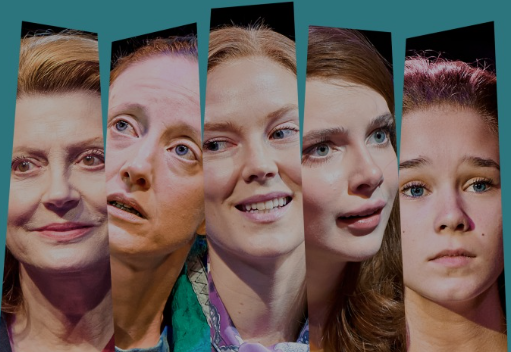
Mary Page observes that preparing someone’s taxes is more intriguing than it might seem, as it enables you to construct a vivid portrait from little more than a shoebox of receipts—and this is precisely what the play compels the audience to do. The play traces the life of Mary Page Marlowe’s from birth to near death through 11 fragmented vignettes, brought to life by five performers (and a baby doll).
We watch the scenes in fragmented order, piecing together the story from the scattered clues. By pushing us to discern cause from effect, the play repeatedly challenges our own assumptions about why things in life happen the way they do.
I really appreciated the nuance of this play. It is not a story of a woman wronged by the men in her life, carrying a mental load and all the woes and problems on her own shoulders. Both her parents contributed to her dysfunction, just as she and her first husband shared culpability for their family’s unravelling.
In this kaleidoscope, we catch a glimpse of Mary Page from every angle, yet see very little of her at the same time. The in-the-round staging masterfully heightens this elusiveness: wherever you sit, the actor will at times slip from view, compelling you to infer her expressions, lean in to catch her words, and fill in the blanks yourself. I desperately wanted to find out more about every point of her life; most of all I was hoping for more exploration of how, in the end, she found equilibrium with her third husband, how she reconciled with her daughter, and how she finally found peace.
But that is the point I guess: we can never truly know another person, nor, for that matter, ourselves. The latter is very much reflected in the poignant silence when the therapist asks Mary Page about decision points in her life. Thinking back on the play, you imagine that all the scenes shown to the audience are flashing through her mind at that moment, as she tries to envisage what her life might have been like had her choices been different at those junctures. The uncomfortable question lingers: to what extent do we ever truly has agency in our lives, or is it simply that “nothing we do is going to change the cards”?
The use of different actors playing the same character at different stages of her life illustrates the complexity of any individual life and the contradictions within us. In that context, the quilt metaphor at the very end feels unnecessary and rather heavy-handed. That being said, the reference to the panels coming from different women – rather than from fragments of her own life – does introduce a fresh perspective. Though the play centres on Mary Page, she stands for generations of women whose lives have been marked by similar challenges, tragedies, and moments of happiness. Womanhood rather than woman, brilliantly acted out by an absolutely superb cast.