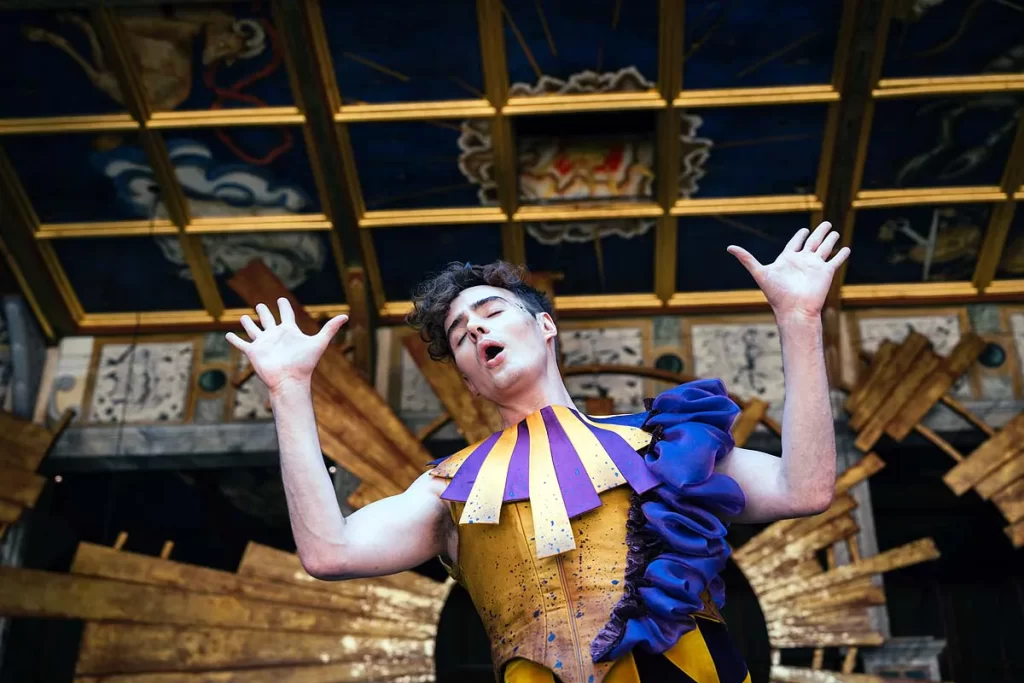
The Fool, in Harlequin’s attire as the central figure of this production of Twelfth Night, probably tells you all you need to know about Belfield’s direction for this staging – vibrant japery and frivolity lacking nuance or subtlety. It’s all colour, exciting visuals, dance, costumes, revelry and clowning about – something between the Venetian Carnival and Cirque du Soleil, set against the backdrop of a massive, stylised, beaming bronze sun.
All the crazy energy and masquerade is undoubtedly funny at times, aided by the considerable effort to create moments of brief and irrelevant, but nonetheless hilarious, engagement with the audience. But at some point, it all becomes a bit much. The cast play in a very melodramatic manner, high on performance, low on emotion. The exaggerated delivery and the larger-than-life movements, whilst at first amusing, over time become too much. What is more, the lack of any authenticity to the emotions starts to feel increasingly like poor acting, and without the sprinkle of credible infatuation, the plot ceases to make sense.
Most notably, it is impossible to comprehend why Olivia falls for Cesario, who is hardly silver-tongued in their interactions. Nor is it clear what it is about Orsino that makes Viola adore him. At least we know from the script that she adores him, since there is no indication of her being lovesick in the scenes between them.
There is, of course, the mandatory queering, which, in the case of a play revolving around gender-switching, is arguably fair game. However, the kiss between Sebastian and Antonio disrupts the narrative. It detracts from the profound relationship between the two men, rooted in loyalty and trust, and diminishes the heart-wrenching impact of the sea captain’s mistaken belief in betrayal. It also casts Sebastian as somewhat frivolous, rendering his sudden willingness to marry out of character.
And so, when it all reaches its culmination, with Sebastian replacing Viola and Viola winning her Duke, it feels as though someone has merely moved pieces on a game board. There is no magic to make it believable or to fill you with joy at a happy ending. You realise the play has concluded, but your heart remains unfulfilled.
So, what you will not get out of this is food for the soul, but you will get plenty of laughs.