Spoiler alert – this is a new play – do not read on if you don’t want to know about what happens
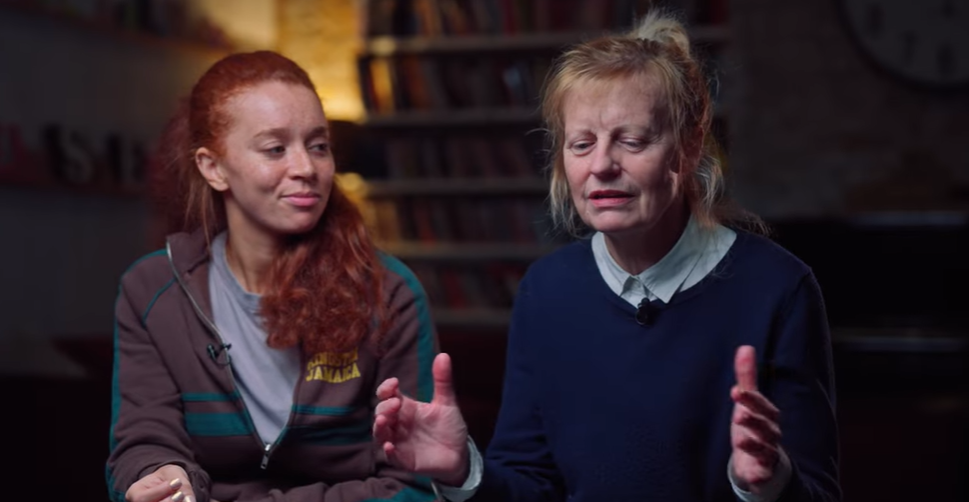
There is very little positive to say about Anna Ziegler’s Evening all afternoon at the Donmar. For a play about the importance of connecting, it really does not connect.
I suppose it did at least send me to Wallace Stevens’ Thirteen Ways of Looking at a Blackbird, which I had not read before — a poem that treats thought as a series of fleeting moments rather than one clear idea. Its structure is fragmented and demands close attention; you have to read it with patience and give it time for its meaning to unfold. It is, in its own way, rather intriguing.
The play, unfortunately, is not. And with time, all that happens is that even more of its weaknesses become painfully obvious. Because this is an astonishingly weak and frustrating two‑hander, made worse by the fact that one of the two actors is simply not up to the task. Anastasia Hille, it should be said, is very good, displaying an impressive mix of crushing fragility and unwavering strength. Erin Kellyman, unfortunately, is not. Even allowing for the fact that this was a preview, she stumbled over lines and seemed unsure how to pitch the performance — half delivered as grand, declamatory monologue, half drained of any real emotion. Increasingly, I am convinced that if you learned your trade on the silver screen, you need to stay off the wooden one.
But frankly, even if Kellyman were the perfect mix of Maggie Smith, Helen Mirren, and Dame Judi Dench, it would not have made an iota of difference given how fundamentally flawed the story is itself. And don’t get me started on the mother‑daughter rhinoceros analogy. I am fairly certain I produced subtler metaphors in my high‑school creative writing homework.
It is the closing sequence, however, that is most dispiriting and makes it impossible to salvage the evening by attributing some clever interpretation to what came before. Posthumously, Jennifer reads out a letter to her stepdaughter — the same stepdaughter who has spent the entire play being petulant, self‑absorbed, knowingly cruel, and entitled. The stepdaughter who occupied her house, stole her mother’s things, and treated any attempt at kindness with open hostility. And yet the letter appears to thank Delilah. Thank her for being a role model. Thank her for giving Jennifer the “cheek” to stand up to her own overbearing mother — but wait for it — in a dream.
The idea that Delilah’s sustained cruelty had somehow been a gift is baffling. There is no credible justification for her behaviour. Yes, her mother died when she was young; yes, she missed a parent. But grief is not a blank cheque to behave atrociously, particularly towards someone making genuine efforts to show care. For a while, I found myself hoping that the writing was deliberately building towards Delilah experiencing a full psychotic break. Had the play committed to depicting a psychosis — and then spent time on Delilah confronting it, dismantling it, and rebuilding her world — that might have earned the emotional resolution it so clearly wants. But it does not; instead, everything is minimised as “a wobble” that a good sleep should have resolved.
This is not merely unconvincing; it is absurd. This is a character who has been conversing with the ghost of her dead mother for months. Who has locked herself in her room, unable to function, subsisting on crisps. Who has dropped out of university, imagined a gun, and fantasised about killing her stepmother. And yet Jennifer manages to pull her back from that ledge and seemingly outright cure her with a reassuring “it’s just a wobble”. Twenty‑five years later, Delilah is a mother herself — conveniently transformed, uncannily similar to her own. No reference to any wobble. She is now perfectly adjusted and remembers her stepmother with fondness.
What a load of wobble.
Leave a Reply