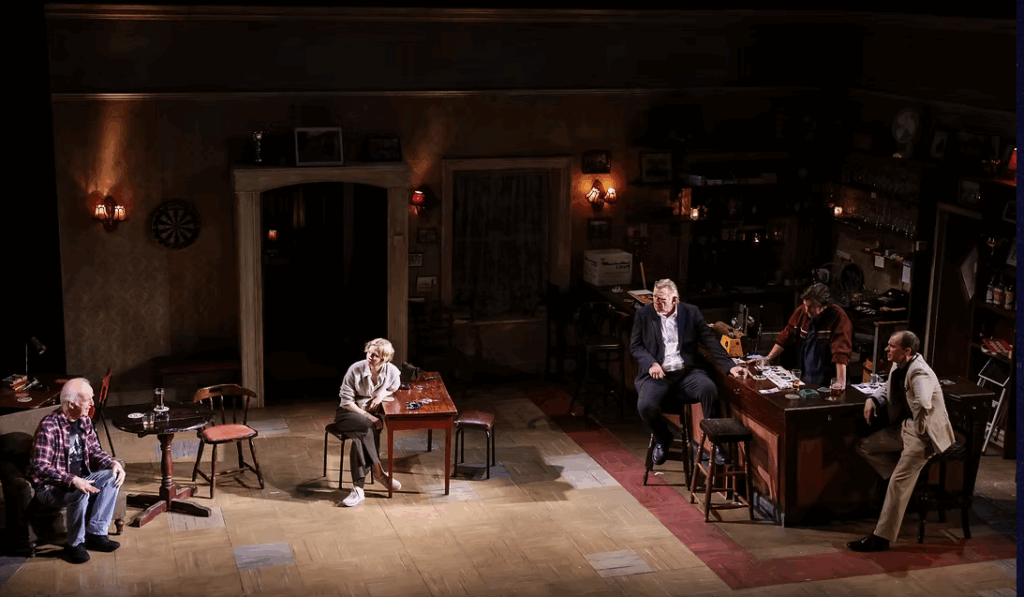
Have you ever gone for a walk, only to feel a bit cold or weary and decide to duck into a pub for a rest? You order a pint, or perhaps a hot drink, and settle down with a book—until a group of old mates ambles in. No matter how you try to focus on the page, your attention drifts towards the conversation they are having. And the stories are interesting, maybe even fascinating. Yet there is no ‘so what’ to them, they are just some tales they swap.
This is what this play feels like – a session of inadvertent eavesdropping, very pleasant eavesdropping, but not much more. I really struggle to understand the accolades this piece has received, such as the Olivier Award for Best New Play in 1999 (maybe that says more about the calibre of plays written that year more generally) or being listed among the 100 most significant plays of the 20th century. Again, maybe this means the 20th century lacked great dramas, but Michael Billington including it in his The 101 Greatest Plays, is for certain not one, but several steps too far.
Don’t get me wrong, I actually really enjoyed the evening, even if I struggled to understand Gleeson (whenever we watch Irish dramas on television, I have to have the subtitles switched on).
That said, the actors’ ages struck me as an odd decision: the men are a good 15 or 20 years senior to their characters. It disrupts the narrative’s subtle undercurrents, particularly the hint that Valerie might choose to stay in the village, envisioning a future with Jack. With Gleeson a sprightly 70 year old and Kate Philips just a fraction more than half that at 36, it is very hard for that possibility to be credible. And that glint of hope is something that turns all the stories into more than tales – it suggests that if we just find the time to talk to one another, and listen, we will all be happier for it. An important message in this digital age, so it is a shame it was drowned out, not amplified.