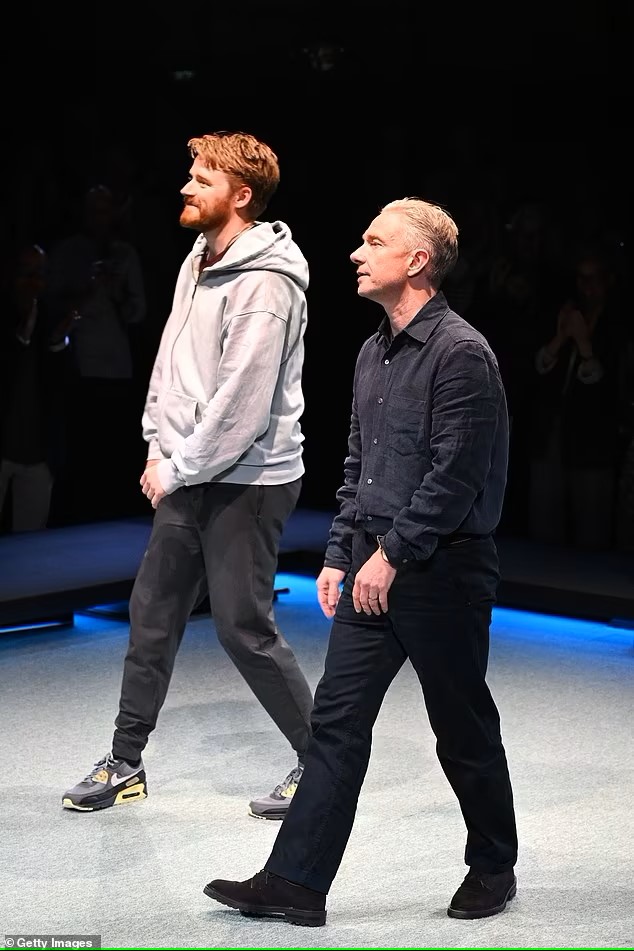
This is a short, but powerful play. It has similarities to Ireland’s Ulster American, in that it opens with quick, cuttingly funny dialogue, that is both smart and thought provoking and then morphs into something more menacing. But unlike Ulster, the Fifth Step does not descend into a pointless farce and ends with something close to a cliff hanger instead.
The story line is about an AA sponsor and sponsored. Not something I can relate to, having no knowledge about how the programme works beyond what is commonly portrayed in movies and TV dramas. Maybe for this reason, my mind focussed on something that has always troubled me – talking therapy more broadly. I have never been to therapy but know many who have and who found it very helpful. My own interest in it began when I realised that I felt ill equipped to have conversations at work in my role as counsellor to junior colleagues. It is a role that comes with seniority, but one for which training seems quite perfunctory and focussed on administrative aspects.
So I began educating myself. I quickly devoured books by Yalom, then moved on to more technical literature, finding transactional analysis especially relevant to my particular context. But the more I read and the more people I interacted with in a counselling, coaching and mentoring capacity, the more doubts I began to have. I realised how vulnerable the person can become, how trusting and susceptible to influence, how unlikely they are to challenge guidance and advice. It dawned on me what destructive power a bad therapist can wield – not because they have bad intentions, but because subconsciously they might project their own issues onto the person they are supporting.
And this is what the story was about for me. Watching the two men interact, I kept switching my allegiance constantly. The brilliant acting made their exchange so utterly believable. Luca, played by Lowden with fidgeting energy, seemed like a version of John the Savage from the Brave New World, unfiltered and uncouth. James, played by Freeman, whose facial expressions are second to none, socialising him into the ways of a recovering alcoholic. He seemed so blunt, even cruel at times, but as the sponsor, convinced that this was the right way, the only way to yield results. And it seems to be working, at least at first. But then things start to unravel as it becomes clear that James not only does not have all the answers, but is allowing his own mistakes and insecurities to permeate what he does as the sponsor.
What is possibly most worrying, is that he clearly derives great personal satisfaction from the power he has over Luka and wants to hold on to it more than he wants to see the younger man succeed. The closing line when James asks Luka to go for a drink, casts a sinister shadow. You leave the theatre wondering whether there will be a sixth step.