I appreciate that conversations at my dinner table may currently be far removed from most people’s everyday experience. With two children fascinated by religion, philosophy as well as drama, and English literature A-levels and science GCSEs on the go simultaneously, our evening conversations regularly involve debates on the god argument interwoven with circle theorems and Shakespearean references.
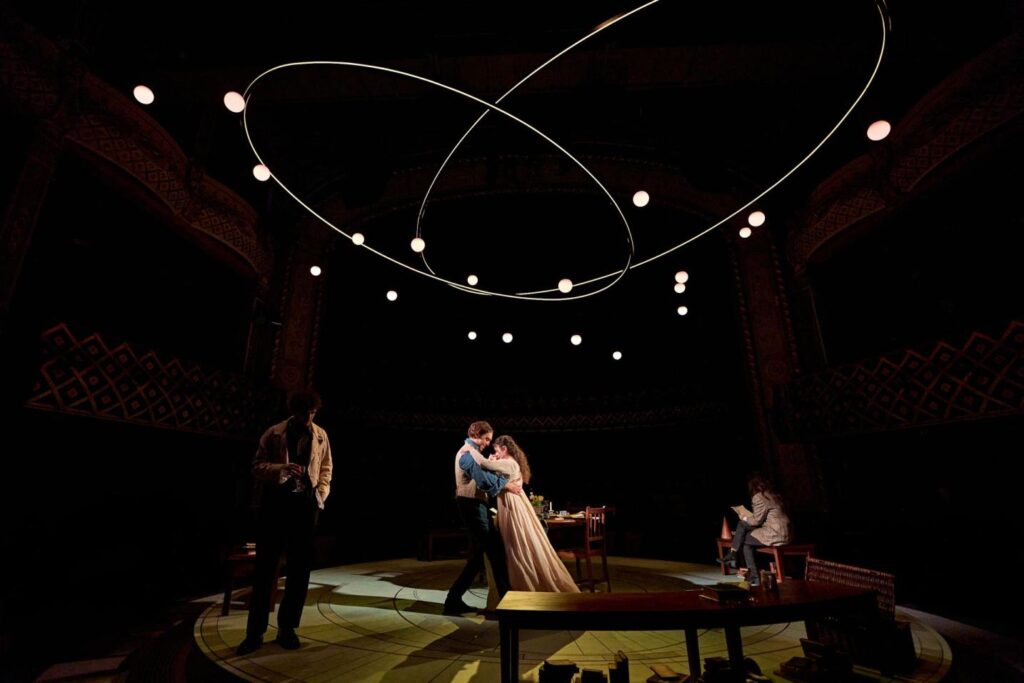
Perhaps that is why watching Stoppard’s Arcadia felt like stepping into a dramatised extension of my everyday life. In my mind, I pictured Merlin from Disney’s The Sword in the Stone waving his magic wand, tossing in a dash of Oscar Wilde’s wit, the sparring energy of sharp-tongued Benedick and Beatrice, and a hint of Agatha Christie detective story, all swirling together in the round beneath a mobile that resembles both planetary orbits and atomic structures
Because in this single room, played across two time periods, everything becomes a mirror, reflection, or echo of something else. The present mirrors the 19th-century past; the mute Gus is a parallel to the chattering Thomasina; iterated algorithms are simply AI writing its own code. In the past, Lady Croom asks her landscape gardener why he has built a Hermitage without a hermit. He suggests advertising for one in the newspaper. “One could hardly believe in the veracity of a Hermit who took a newspaper,” she ripostes with cutting precision. In the present, Hannah calls out the sham: “It’s what happened to the Enlightenment, isn’t it? A century of intellectual rigor turned in on itself. A mind in chaos suspected of genius. In a setting of cheap thrills and false emotion…The decline from thinking to feeling, you see.”
I love that this play is knowingly brilliant and intellectually stimulating. I am tired of everything being dumbed down, tired of trigger warnings, tired of clunky exposition explaining how a mystery was solved. I don’t want a Starlight Express with toy trains coming to life. I want a play where every thread you pull or idea you catch leads somewhere worth following. This blend of free will versus determinism, chaos theory, entropy, classicism and gothic romanticism, garden history, classical literature and philosophy, Fermat’s Last Theorem, iterated algorithms, Lord Byron and Newton’s law of thermodynamics is exhilarating.
Yet this marvellous, sophisticated, cerebral play is also filled with warmth—especially in the relationships between the precocious Thomasina, not yet fourteen, and her Cambridge-educated tutor Septimus, twenty-two; and, in the present day, between Hannah and Gus.
I adore the boundless curiosity and astonishing intellect of Thomasina’s character. Again, there are two parallel strands to her: a woman of wide‑eyed, open‑minded wonder and mathematical brilliance; and a beautifully naïve girl who loves rice pudding and is curious about ‘carnal relations.’ She encapsulates the fundamental head–heart dichotomy of life and humanity.
Thomasina’s attempt to map the unpredictable sits beside a present-day reminder that some human behaviours cannot be predicted or comprehended. The news cycles are dominated by the Epstein files and the powerful, clever men whom Thomasina’s algorithmic equation could never have accounted for. The corrosive mixture of power and exploitation are testimony that the patterns we seek in nature can never fully account for the abandonment of reason, morality and ethics we end up uncovering.
Leave a Reply