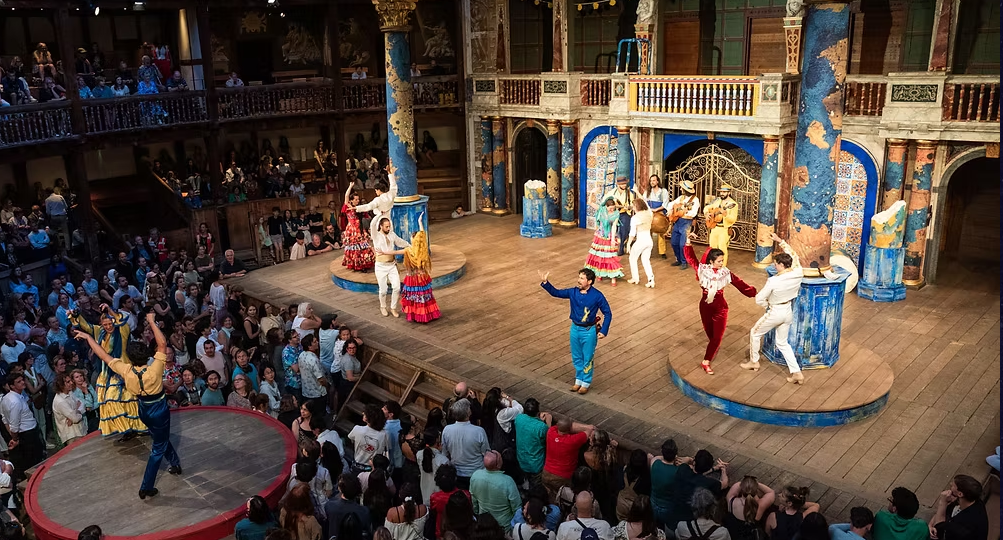
Love’s Labour’s Lost is apparently one of Shakespeare’s least-performed comedies, probably because the plot is surprisingly thin, it contains an extraordinary amount of wordplay, and its refusal to offer immediate gratification makes for a somewhat frustrating ending. As such, I had never seen it before and, despite strong reservations when I read that this production would come with a flamenco twist, I decided to give it a shot.
We went near the end of the run, with my daughter and her girlfriend. It was an early September evening and, as the skies cleared and we took our seats, the Spanish sun seemed to burst onto the stage. What followed was one of the most bizarre, rambunctious and utterly delightful productions I have seen for some time. The girls spent much of the evening laughing out loud, particularly at the archaised versions of Despacito, Livin’ la Vida Loca and Tití Me Preguntó (a Bad Bunny song, my daughter kindly explained).
Adieu becomes adios, there are references to cojones, and a repast turns into a paella. The deer hunt of the original is reimagined as a choreographed bullfight, with Pablo Egea magnificent as the animal, dancing through every stage of a corrida. Flamenco songs and dances accompany the action, the passion feeding into the production’s streak of good-natured bawdiness. There is a great deal of innuendo and hip-swivelling, the Muscovites sport massive codpieces, but it remains more playful than provocative.
There is not really much more to add: it is simply a lot of fun. Love’s Labour’s Lost is often treated as one of Shakespeare’s problem comedies, but this production seems to have decided that there is no problem to solve, only an audience to delight. It wraps the Globe in colour, music and movement, creating an atmosphere of such irrepressible good humour that resistance feels pointless. The exuberance on stage is infectious.
At the same time, it is fascinating to see Shakespeare’s workshop in action, with ideas that he would later develop more fully elsewhere. The witty aristocratic women puncture the pretentious intellectual theories of the men, much as Beatrice repeatedly gets the better of Benedick. There is masking and mistaken identity, and there is even a play within a play. Unlike Pyramus and Thisbe, however, the pageant of the Nine Worthies provokes more than laughter. The performers are relentlessly mocked by their audience until the entertainment begins to collapse. Yet the audience within the play is behaving exactly as a real theatre audience might. It is almost as if Shakespeare is inviting us to think about what acting is, what performance is, and why people take such pleasure in watching other people fail.