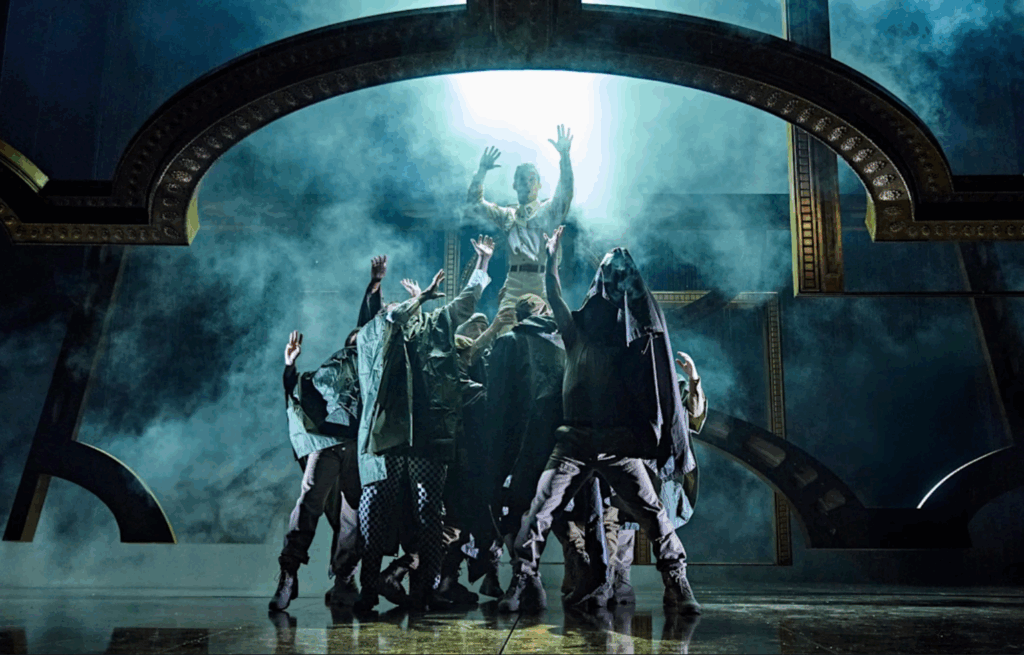
My gaze was drawn to the stage immediately. I was instantly mesmerised by the ancient elegance of gilded arches that created exquisite depth and perspective. They seemed like stargates, mirrors, windows, or worldly doorways pulling me in.
As the play unfolded, the staging, lighting, and projections remained captivating, sometimes to the point that I almost lost track of the actors moving within them. The tempest completely took my breath away. Sliding mesh screens conjured corridors, intimate hiding places, a late-night bar. Clever projections gave the illusion of rain and moonlight. When those same screens—subtly reflecting the faces of the protagonists in a kind of ghostly evanescence—parted, they became a literal foreshadowing of the tragedy to come.
Against this opulent backdrop, the costumes felt like a bland afterthought in some cases and an outright crime in others. An extraordinary amount of effort seems to have been expended on making the gorgeous, tall and slender Caitlin FitzGerald look as unattractive and sexually unappealing as possible. I can see no credible justification for Desdemona spending most of the second half dressed in a green potato sack. In fact, her costuming directly contributes to what I consider to be the production’s central weakness: the portrayal of the marriage between Desdemona and Othello.
Casting an actress in her mid-forties opposite a man approaching sixty was always going to be a risk, yet only last year Lesley Manville and Mark Strong in Oedipus proved that passion is not the exclusive preserve of the young. There, the tension was palpable. Here, the couple connects on a purely intellectual level; their union feels safe, chaste, based on rational compatibility devoid of the slightest sprinkling of desire. When Desdemona pleads her case before her father, she sounds less like a passionate bride defying the world for the love of her life and more like a mature woman calmly choosing a suitable companion with whom to leave the family home.
I do not deny moments of tenderness, particularly in the way Othello looks at his wife, but there is no hint of the honeymoon period. And that matters profoundly. Jealousy is meant to be the engine that drives this play, and sexual jealousy its fuel. If the marriage appears high on logic and low on lust, the jealousy plot simply fails to ring true.
That is exactly what happens here. Iago’s poison drips steadily into David Harewood’s ears, but its ability to ignite a murderous fire in his soul seems unsubstantiated. Harewood’s Othello is too commanding, dignified and measured for the primal reaction that ensued. When the murder scene begins to unfold, the couple look so incongruous between the marital sheets that their struggle resembles an awkward attempt at foreplay, eliciting laughter from the audience, not gasps of horror, even though the ultimate outcome is well known to all
Nor, oddly, does jealousy feel like the driving force behind Iago’s malice. Cassio’s promotion barely registers, the cuckoldry rumour feels implausible given Othello’s apparent lack of libido, and any racial resentment toward a black man in power is diluted by the presence of other black actors—including Jude Owusu as the Venetian nobleman Lodovico.
None of this detracts from Toby Jones’s superb Iago. He lurks in the shadows with a wicked half-snarl, largely emotionless, pulling strings with patient, almost surgical pleasure simply because he can.
This is a beautiful, impeccably executed production, sumptuous and polished. But I had gone to see something raw and dripping with jealousy, not a flawlessly delivered exercise in studied choreography.