In my country, Molière’s canonical trio of comedies, Tartuffe, The Misanthrope and The Miser, occupy a special place in the repertoire. For years, I’ve wondered why London theatres seem so reluctant to revisit them. This season, however, I’m being spoiled: both Tartuffe and The Misanthrope have returned in modernised forms. I still have Tartuffe to look forward to. But first came The Misanthrope.
Anyone who knows me will attest that, while I’m not a full-blown misanthrope myself, I’m not exactly a bucket full of rainbows either. The world keeps changing and, with impressive consistency, continues to provide fresh material. It is hardly surprising, then, that Martin Crimp has returned more than once to The Misanthrope. On paper, I should have been the ideal audience member for a contemporary reimagining. Yet the further this adaptation progressed, the less persuaded I became. It seemed to me that Crimp had strayed too far from Molière and, in the process, lost his way.
Molière worked on The Misanthrope for some five years, longer than any other play in his career, and is said to have regarded it as the finest of his works. In the original 1666 production, Molière himself played the embittered Alceste; Célimène, the young woman he loves and mistrusts, was played by his wife, Armande Béjart; and Éliante by Madeleine Béjart, Molière’s long-time collaborator and, quite possibly, former lover. The play’s premiere in 1666 was only a modest success, but its reputation grew quickly. By the eighteenth century, it had come to be regarded by many as Molière’s masterpiece. Voltaire even declared: “Le Misanthrope est le chef-d’œuvre de Molière.“
It is easy to see why the play took time to earn its reputation. Devoid of the broad farce and comic justice audiences expected from Molière, it is a work of high comedy that invites reflection as much as laughter. Alceste, after all, is neither villain nor fool. He may be a merciless critic of social hypocrisy, but he falls helplessly in love with Célimène, a witty and socially adept young widow who embodies everything he professes to despise, exposing his own hypocrisy in the process.
But with the gender flip, the widow becomes a divorced father of two: a self-absorbed addict who appears willing to prioritise his acting career over the welfare of his children. Crimp further obscures the situation by leaving it unclear whether Stefan is cheating on Alice. If he is, the implication is that some of his affairs are with much younger women, introducing an age gap that feels uncomfortable. All of this changes the dynamic completely. It is not that Alice’s critique of society disappears, but rather that it has to compete with a host of other concerns for our attention. Stefan is no longer the antithesis to Alice that Célimène is to Alceste. He is something else altogether.
In changing Stefan, Crimp alters the moral balance on which the play rests. After all, what kind of woman would ask a man to leave his children to go and live off-grid with her?
This has consequences beyond the central relationship. John’s role, like Philinte’s before him, is to argue that Alice sees the world in overly black-and-white terms. In Molière, that position is ndefensible. Here, it feels harder to sustain. Crimp asks us to contemplate flaws that go well beyond social insincerity, yet the play continues to frame the debate as though it were simply a question of being a little more tolerant of the human condition.
Add to that the fact that the list of concerns is seemingly inexhaustible: clickbait, cancel culture, online pile-ons, rampant inequality, cynical attempts to control the narrative, female empowerment, patriarchy, misinformation and the politics of identity, with a few digs at theatre and bad writing thrown in for good measure. I am not suggesting that these are not all valid, but I am not convinced they all belong in the same play, especially when they are introduced only to be abandoned moments later. The Misanthrope may be packed with contemporary references, but few of them are explored with any depth. Much like the Berlin literary prize storyline and the attempt to cancel Alice, they simply drift away without consequence, leaving little to reflect on once the play is over. Other than the absolutely gorgeous staging.
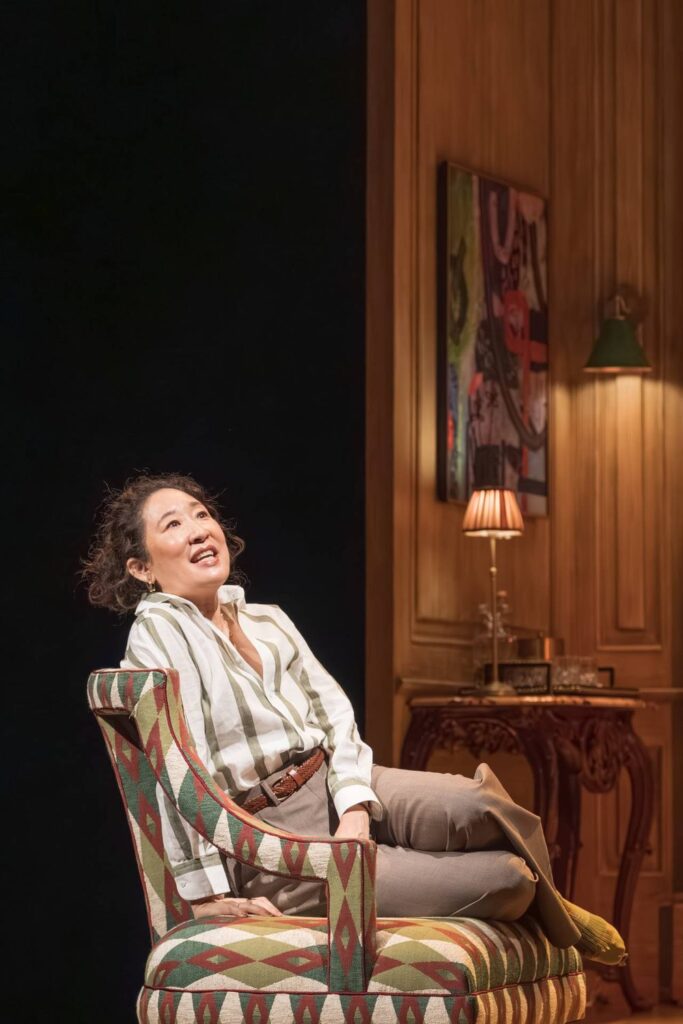
With so many issues competing for attention, I frequently found my eyes wandering towards Robert Jones’s sumptuous set. A series of drawing rooms blend modern opulence with hints of seventeenth-century baroque, creating spaces that feel both luxurious and faintly absurd. The walls are covered with enormous works of contemporary art positioned somewhere between genuine artistic insight and elaborate pretence. That tension, between authenticity and performance, substance and posturing, felt more Molièrean than much of the adaptation itself. In the end, it was the set rather than the script that most successfully captured what the The Misanthrope is.