I’m not sure I’ve ever laughed as much in a theatre.
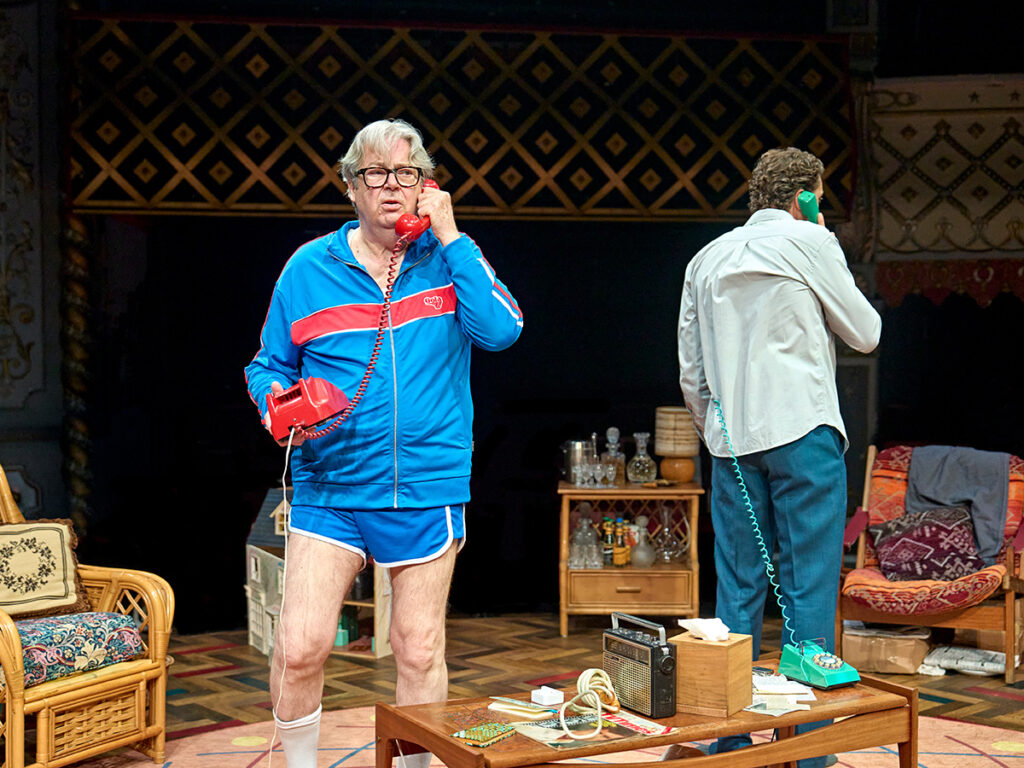
Alan Ayckbourn wrote in The Crafty Art of Playmaking that the “superimposed composite set” in How The Other Half Loves “contributes enormously to the storytelling and, incidentally, brings about fifty per cent of the laughs”. Sitting in the middle of this production, as the play was intended to be seen, I can only agree. This is an astonishing piece of theatrical choreography.
Two households occupy the same physical space. Half a table belongs to one family, half to another. Conversations overlap, collide and occasionally seem to answer one another across different homes. The effect is dazzling, creating a stream of misunderstandings, double meanings and near misses that had the audience in near-constant hysterics, as though someone had forgotten to switch off the canned laughter.
The intricacy never ceases to delight. You are constantly aware of the challenge facing the performers and of the precision of comic timing required to make it work. The production is beautifully observed in smaller details too. Rob Howell’s costumes feel completely authentic and richly characterful. Fiona’s wardrobe in particular tells its own story, reflecting someone with the means, confidence and determination to present exactly the right image. The care and attention to detail throughout is astonishing.
Roger Allam gives a wonderfully warm performance as Frank Foster, a bumbling, forgetful older man whose good intentions invariably make matters worse. Dorothy Atkinson is equally good as his increasingly exasperated wife. Teresa and Bob display the recognisable tensions of a couple with a young baby, both convinced the other is not pulling their weight. William and Mary, by contrast, are played as much broader comic caricatures. Their awkwardness generated plenty of laughs, although at times it felt unnecessarily overplayed compared with the more naturalistic performances elsewhere.
For all the incredibly funny dialogue and faultless comic timing, there is also an uncomfortable undercurrent running beneath the comedy. These marriages are not especially happy ones and the characters feel trapped. Manipulation, control and casual emotional cruelty are all too visible. Adam Gillen has said that the play reveals “uncomfortable truths about relationships” and that audiences may recognise some of their own relationship dynamics in its absurdity.
That felt true. Ayckbourn, however, never labours the point and laughter, not those darker currents, is the overwhelming memory. After some of the more harrowing plays I have seen recently, such as Sting and Firebird, it was a pleasure to laugh this hard and go home smiling.