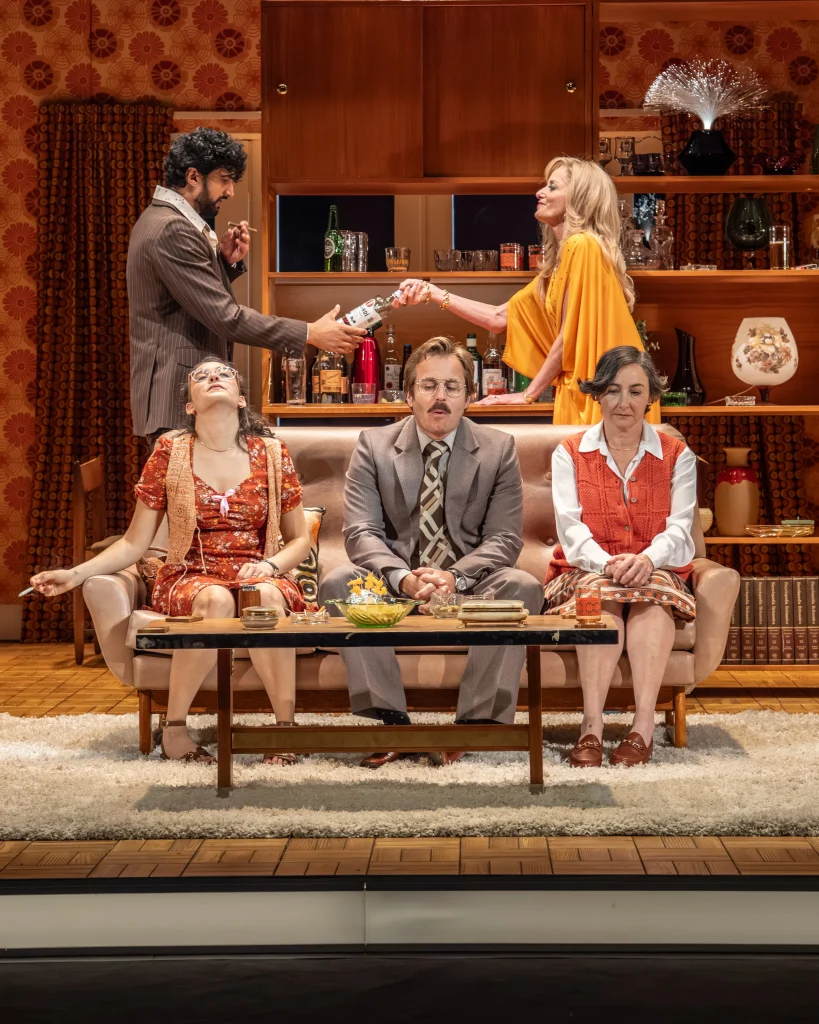
Laurence and Beverly, a solidly middle-class couple, have invited the neighbours over for drinks and a little cheesy pineapple. Their guests consist of a younger couple anxiously feeling their way into suburban respectability and Sue, a divorcée who has fled her daughter Abigail’s birthday party next door.
Not being from the UK, the cultural significance of this infamous party had completely passed me by. I had no idea that, over years of hosting friends around my dining table, I had inadvertently been channelling my inner Beverly, repeatedly asking whether anyone fancied a “little top-up” and being quite insistent that they all did.
Hopefully, that is all the Beverly I have in me, as she is a nasty combination of Mean Girl and cougar. Wafting in an orange kaftan maxi dress reminiscent of Ancient Greek drapery, Outhwaite absolutely nails the role. Almost camouflaged against her glorious tangerine living room, with its floral wallpaper and geometric curtains, she is the ultimate Essex housewife. The fibre lamp perched on a 1970s room divider feels less like a prop and more like an extension of her blonde permed mane, as does the shaggy sheepskin carpet.
She is constantly undermining Angela whilst trying to mask a regional accent; flirting with her husband, but only when others are watching; plying Sue with alcohol with complete disregard for her protestations; and subjecting her own husband to a stream of put-downs that betray years of contempt. That contempt stems, at least in part, from the fact that Beverly is unashamed of her adoration for Demis Roussos and kitsch erotic paintings, whilst Laurence insists on Beethoven and Van Gogh.
Laurence may be desperate to appear cultured, but Beverly is equally invested in the performance of status. He hides behind unread, leather-bound classics; she hides behind oppressive hospitality, alcohol and relentless conviviality. For all the brutality she exhibits, there is something Flaubertian about the boredom and monotony of the suburban aspiration in which she is trapped. Her cruelty is born of dissatisfaction; she is starved of attention and intimacy, frustrated and lonely. But I was never Team Emma, and I cannot really be Team Beverly either. None of this exonerates her passive and overt aggression.
Tony and Angela are not a happy couple either. Tony is filled with utter disdain for his wife and bullies her even more savagely than Beverly treats her husband. In fact, Tony’s treatment of Ange, and his unexplained return from Abigail’s party in a wet shirt, is possibly the most sinister element of the play. Nothing he does seems to shake the false cheerfulness emanating from Ange. It makes you wonder how much practice she has had.
Leigh has described the play as more complex than people often give it credit for, and I think he is right. Abigail’s punk-soundtracked party next door may well have been more fun than the one we got to see, but I never felt any FOMO. Watching the disintegration of marriages, while the only seemingly sane person is the one who is divorced, feels like a particularly interesting perspective on life as I approach my twentieth wedding anniversary.