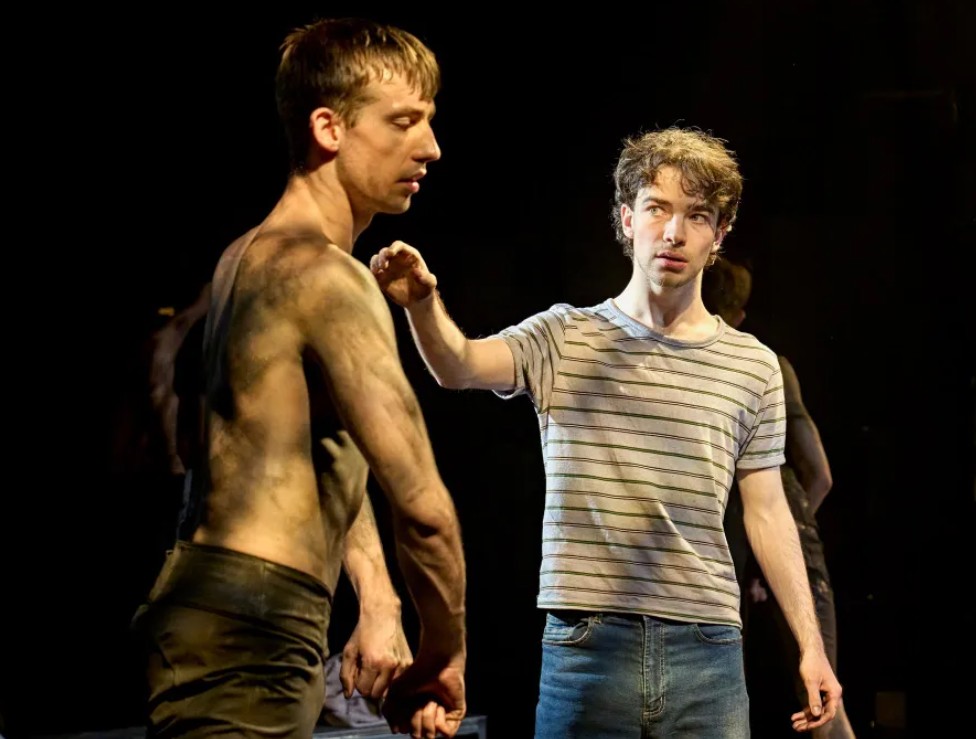
I chose to see this production of Equus for slightly odd reasons. Firstly, because I had never been to the Menier Chocolate Factory. Secondly, because I was curious about the kind of role Radcliffe had chosen in order to de‑Potterise himself.
Before I get my ignorance off my chest, I would like to start by saying that Menier punches way above its weight. This was an exceptional production with some truly great acting and superb movement. Lindsay Postner uses the small size of the Menier to create unnerving intimacy. James Cousins creates horses out of men without the need for any gimmicky mesh headpieces. And Noah Valentine’s performance is heart wrenching. As a mother to a boy of exactly Alan’s age, the range of emotions he made me feel was frightening.
With a bit of hindsight, I should have done some homework. I’ll admit that, as a straight audience member, I don’t always instinctively read queer subtext. It was hard not to clock the disproportionately large number of gay couples in the audience — a bit of a tell, really — but even that didn’t quite push me to consider that the play is often read as a metaphor for the suppression of same-sex desire.
The more I think about it, the more I realise that something in me resisted making that connection — as if drawing that parallel might itself feel reductive or even faintly bigoted. Even with a striking image of a gorgeous naked boy kneeling in front of six very sculpted men, I found myself questioning that reading: does framing it this way risk suggesting that gayness has to be expressed through something so stylised, or even demeaning?
I found these brief personal reflections from Dan Rebellato, Professor of Contemporary Theatre at Royal Holloway, very enlightening. They helped me make much better sense of the play after the fact. The reason none of the narratives offered as explanations for the boy’s obsession quite land is that same-sex attraction is innate and, like gravity, doesn’t require explanation to be real. That being said, this interpretation does throw out some other inconsistencies that keep niggling at me.
It also clarifies why the final speech feels so unconvincing when read as the culmination of an unhealthy, destructive obsession, yet makes far more sense when understood through the lens of gay conversion. And that, in turn, raises more complicated questions — especially in the context of current debates around banning conversion therapy. Banning attempts to “convert” sexuality, absolutely; but if a story like this is taken at face value, it also raises a separate and more uncomfortable question: how do we distinguish between something innate that needs no fixing, and behaviours that genuinely are harmful and might?