I am a massive fan of Oscar Wilde’s wit, so imagine my excitement when I saw An Ideal Husband was being staged. A holier‑than‑thou politician linked to an insider‑trading scandal buried deep in the past, unearthed by a letter. And then there’s the infamous line, “Don’t use big words. They mean so little” — a description of contemporary political speech that obfuscates and avoids dealing with real problems by refusing to name them plainly. It’s as if Wilde could see 130 years into the future.
In this context, even the phrase that has had me running for the hills ever since The Seagull (“a unique 21st‑century modernisation”) — here rendered as Nikolai La Barrie directs a bold, new take — didn’t put me off. I guess I never learn…
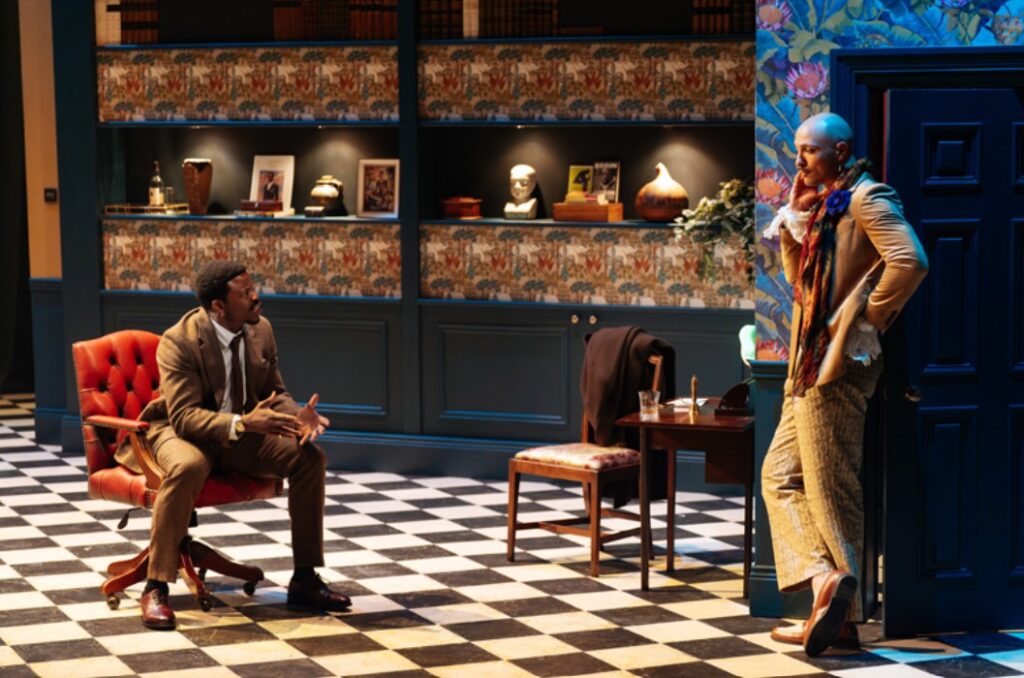
There is an aspect of this production that works — brilliantly, in fact — and that’s the set and costumes. Especially the costumes. I’m not sure how they all fit together, or what the kaleidoscope of colours is trying to paint, but the result is undeniably beautiful. Unfortunately, Rajha Shakiry’s talent cannot make up for its absence in some of the cast, and her gorgeous wallpapers cannot paper over the cracks in the production.
Sadly, once the decorative surface is stripped away, there’s no coherent idea holding the production together. Advertised everywhere for its “all‑black cast,” and with the opening scene introducing Lady Markby and the Countess of Basildon in gorgeously vibrant head‑wrap scarves, speaking in West Indian accents, I expected the bold new take to mean the play had been translated into a new setting — perhaps a non‑descript Afro‑Caribbean island. I found myself wondering how Wilde’s words would be adapted to create something genuinely fresh. But beyond a vape and the occasional mention of Obama, Beyoncé, and Claude, it was pretty much the traditional script.
Which meant that a lot of what was being done around the edges really did not make sense. Starting with the accents. Why do some members of the upper classes have strong West Indian accents whilst others don’t? Why does Lord Goring slip into his father’s accent when he is being playful, yet show no hint of it in regular conversation — is this shift meant to signify he is embarrassed by his heritage? And why does Mrs Cheveley — Aurora Perrineau — drift in and out of an American accent? I appreciate that she has come from Washington, but if there is no rhyme or reason to the accents of the other characters, and Aurora is clearly incapable of sustaining one, why bother pretending?
Aurora is, quite simply, the weakest link in the production. Her inability to deliver lines with any emotion, pacing, or understanding is almost an art form. The closest comparison I can make is to my daughter’s drama class, when a child doesn’t show up on parents’ day and someone unfamiliar with the scene is handed a script and told to read. Though even that may be unfair.
Given the importance of her character, this portrayal casts a long shadow over the rest of the play and drains much of the enjoyment from it. I feel for the other actors, some of whom did a genuinely good job. That being said, there was very little acting between the characters, with lines landing more like monologues than exchanges. The standout was Emmanuel Akwafo as Mason / Phipps, whom I had the pleasure of being grabbed by at the Bridge when he played Bottom. Convincing in two very differently rendered roles, he connected both with those on stage and with those in the audience. The fact that his disapproving “humpfs” and flouncy exchanges earned more laughs than Wilde’s brilliant epigrams says a great deal about how flat the delivery of the latter was.
Then there is the overdone campness. I thought the National Theatre’s production of The Importance of Being Earnest was already teetering on the edge of what made sense; here, Lord Goring’s entire persona turns his engagement to Mabel into something that feels actively disingenuous. With his Pirates of the Caribbean eyeliner look, it feels less as though he is in the market for a wife and more as though he is shopping for a beard. As a result, he no longer comes across as a rake on the outside and the most decent, honourable gentleman on the inside, but as someone whose intentions really shouldn’t be trusted. Secretly, I spent the evening pining for Rupert Everett.
Everything is too eclectic; too much has been piled on, with the R&B music frequently drowning out the dialogue. What gets lost in all of this is the sincerity of Wilde’s play and the wit of his writing. There is one scene in which Robert delivers a tirade of hypocrisy so rich in what is wrong with British politics today — and yet it barely raised a smirk from the audience. In this case, the delivery was not the problem; the entire set‑up was.
So I’ll finish with a tirade of my own: some of my favourite lines from the play — for those who saw this production but couldn’t hear them, whether because of poor delivery, loud music, or anything else.
“To love oneself is the beginning of a lifelong romance.”
“Morality is simply the attitude we adopt towards people we personally dislike.”
“I always pass on good advice. It is the only thing to do with it. It is never of any use to oneself.”
“Other people are quite dreadful. The only possible society is oneself.”
“To expect the unexpected shows a thoroughly modern intellect.”
“Fashion is what one wears oneself. What is unfashionable is what other people wear.”