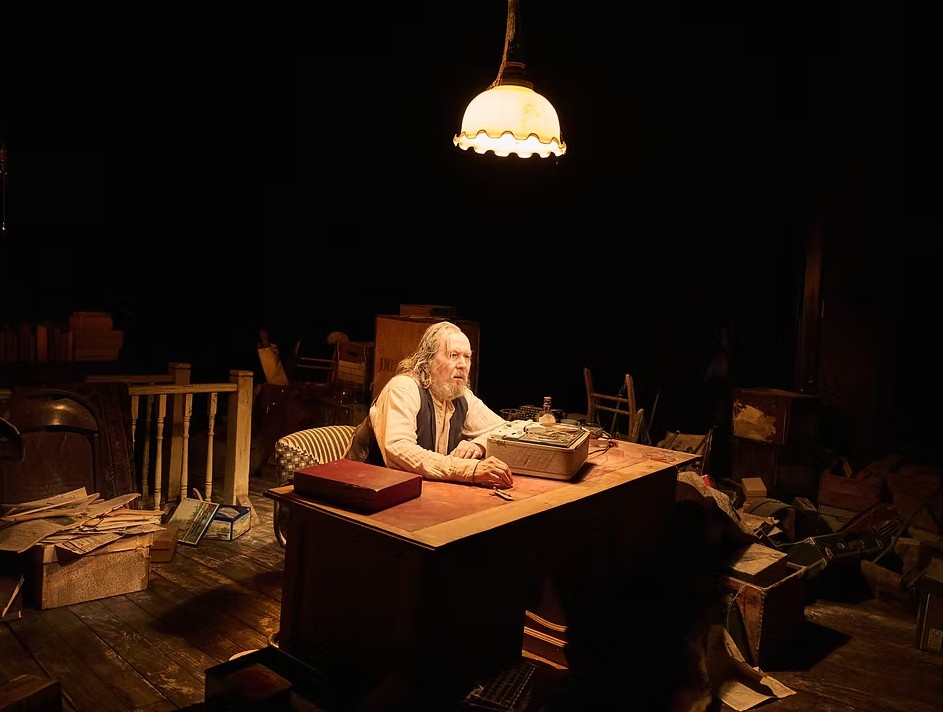
As part of its 70th‑anniversary season, the Royal Court—long the leading force in championing and cultivating new playwrights—has paired Krapp’s Last Tape, one of Beckett’s most frequently performed works, starring Gary Oldman, with Godot’s To‑Do List by Leo Simpe‑Asante, winner of the inaugural 2025 Royal Court Young Playwrights Award, performed by the relatively unknown Shakeel Haakim.
Both plays place a man in conversation with an offstage voice—but is that parallel enough to sustain the dialogue between them?
Godot’s To‑Do List
If we suspend, for the sake of argument, the entrenched belief that Godot does not exist—or that, if he does, he must be God—then the notion that he is delayed by a disembodied voice setting him menial tasks is unexpectedly subversive. God has not abandoned Vladimir and Estragon; he is simply otherwise occupied, detained in some kind of purgatory by a higher female power. What a neat illustration of a simulation within a simulation.
There are also a few genuinely clever nods to Beckett: an existential crisis delivered in a torrent that recalls Lucky’s monologue; the quiet surrender of agency to the to‑do list itself; even the appearance of a carrot and a bowler hat. All the right signifiers of absurdist theatre.
Intellectually, it’s an interesting springboard, even though it bears the marks of a young writer still learning how to refine his ideas. Where it faltered most for me was in the staging. Played as farce, the premise remains clever but lacking in depth. It might have worked better with an older actor, leaning into weariness, resigned to the fact that life keeps throwing shit at you and endlessly distracts you from what you actually want to be doing. Played as fatigue, the piece might have found both a more convincing emotional register and a more credible bridge to Krapp’s Last Tape.
Krapp’s Last Tape
When Krapp’s Last Tape premiered at the Royal Court in 1958, it functioned as an entrée to Beckett’s Endgame. Here, it is very much what everyone has come to see. And despite there being no live spoken words from Oldman for probably half of the production, the audience remains enthralled by the conversation between a man and his memories.
Like all good archivists, he has decades of tape—one recording per birthday. We meet him at sixty‑nine, listening to himself at thirty‑nine, who in turn listens to the man he was at twenty‑nine. He mocks his younger selves; the laughter overlaps. Eventually, though, the tape returns to a relationship abandoned—apparently in service of a literary career that has sold fewer than twenty books.
And this is where Oldman’s brilliance comes to bear. In the play’s final words—“perhaps my best years are gone, but I wouldn’t want them back, not with the fire in me now”—he still manages to introduce ambiguity, making you wonder whether, just maybe, that could be true, even as he gazes unseeing into the auditorium.
I probably have a few more years ahead of me than Krapp had when he recorded his last tape; nonetheless, I hope that when my time comes, I won’t be staring into the void all alone.