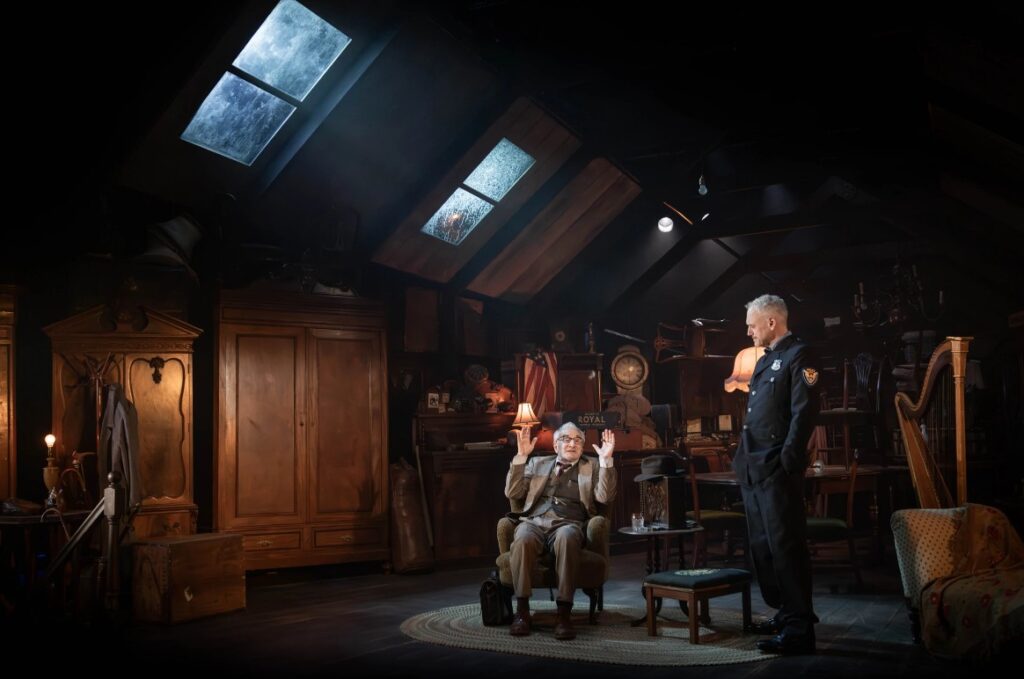
When Victor sweeps his flashlight across the stage and into the audience, the slightly uncomfortable chairs of the tiny Marylebone theatre become additional items about to be sold to Gregory Solomon, and the packed audience an extension of the cluttered attic. Poor ventilation heightens the stifling atmosphere, and the musty smell quickly feels real.
The acting is equally convincing, even if some cast members drift in and out of their accents. The dynamic between the brothers, the wife’s frustration, the way each of the men slowly unravels as they revisit the past — all ring true. Walter fills the stage the moment he enters; Victor remains understated, his tension barely contained; Esther, like fragile porcelain, is forever searching for reconciliation, hoping for a path to a better life.
The title of the play might suggest that those three are its focus — but it quickly becomes clear that the furniture which has brought them together is only an analogy for past decisions, and the stories built around them. What once felt like treasure turns out to be junk of purely sentimental value, its worth impossible to realise in the real world. Duty and sacrifice may have felt noble at the time, but here they have hardened into little more than regret.
But for me, The Price isn’t really about what we owe the past, but about the stories we tell ourselves to avoid the future. Which is why Gregory Solomon steals the show — both in what the character embodies and in the sheer flamboyance with which Henry Goodman brings him to life.
I saw David Suchet in the Wyndham’s Theatre production in early 2019. Goodman outdoes him. He turns the simple act of peeling a boiled egg into both art and statement. His is an over‑the‑top performance, where “birds” become boyuds and “girls” become goyuls — so exaggerated that it edges into a vaudeville caricature of a stereotype, and yet remains perfectly convincing.
Goodman’s comic timing is faultless, but he is not comic relief from the play’s serious concerns — consumerism, the rat race, the trade‑offs between career and family, the suffocating family dynamics. He is the play. An old Jew who left Russia sixty‑five years ago at twenty‑four, smoked all his life, drank, and loved every woman who would let him. An octogenarian of apparent fainting frailty who claims to have been an acrobat and a member of the British Navy; who has lived in six countries, married four times, and is haunted nightly by the suicide of his daughter. This is a man who has fought for everything, repeatedly. But he does not dwell on it. He is not, and will not be, the victim. He will not be ashamed.
Unlike Victor, who has inherited from his father not just furniture but a paralysing inability to move on. Perhaps his father really did need his help — or perhaps Walter is right, and he would have been fine. Either way, sixteen years have passed since his death, and Victor has not changed. The second half of the play drags and feels overwritten. We seem to be going around in circles, repeating the same arguments — but then — maybe — that is just reflective of how we are in real life: unable to break the cycle, unable to move on, stuck in the past, stuck nursing the same old wounds and resentments.
But men like Solomon, with bottomless vivacity, put the past where it belongs and find ways forward. Solomon pops in and out of the room where he is resting like a ferret — serving as a reminder to Victor that at almost fifty he may have as many years ahead of him as behind, and that it is never too late to reinvent yourself rather than be defeated, as his father was. This sentiment is exquisitely captured in a brief exchange when Victor is shocked to learn that Solomon remarried at seventy‑five and asks what the point was. Solomon replies, defiantly: “What’s the point at twenty‑five? You can’t die at twenty‑six?” That difference in attitude says everything.
At the start, Victor plays a “laughing record” which for him evokes nostalgia and regret for a life lost and unreclaimed. I already catch myself having these sorts of thoughts and feelings. Sometimes I allow the anxiety of what AI might bring to overwhelm me. Victor’s visions of “men on the grass” occupy my own thoughts.
At the end, Solomon is left alone and plays the same record. For him, it signals something else entirely: excitement at a new job, another challenge; he laughs in the face of the task at hand. When the phone rings with an unlikely proposition, we all have a choice to make — put down the receiver or take a chance. I hope, I will be like Solomon, and pick up.