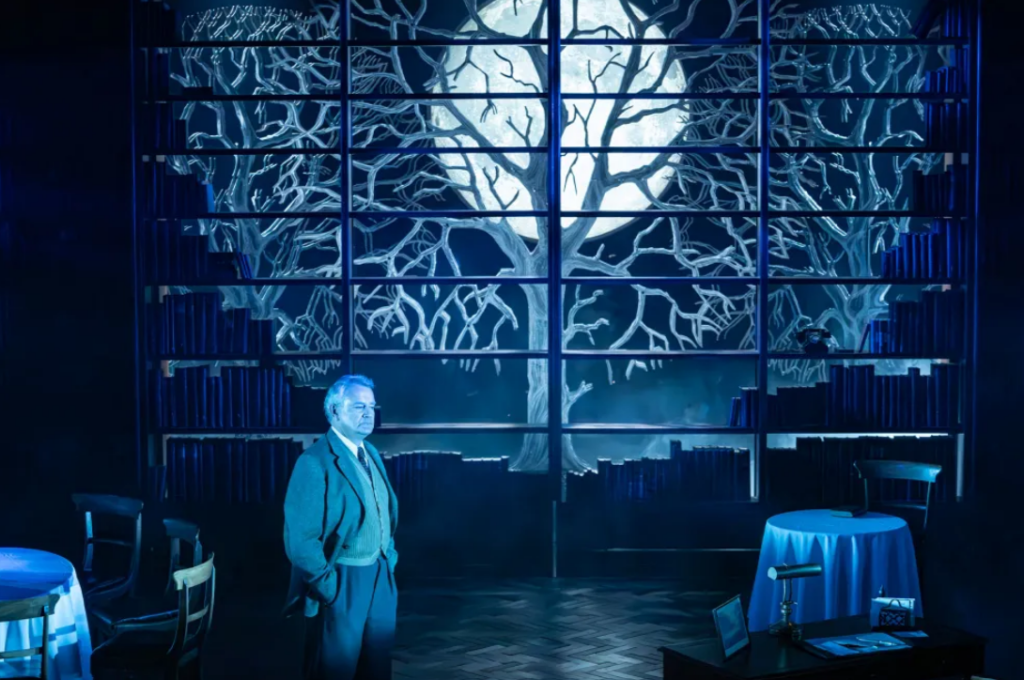
It isn’t a tale of two halves, really; more like one of four uneven quarters. I genuinely enjoyed the first half of the first half: the writing felt sharp, the dialogue quick, the energy alive. Things were actually happening. I wanted to know more. And, with hindsight, a good chunk of that early brilliance may simply have come from borrowing liberally from C.S. Lewis’s own words.
But even before the interval, the pace began to sag. Attention started to drift. The second half opened on a more emotional note and, for a brief moment, it pulled you in again, only to dissolve into a chain of random scenes that didn’t seem to be doing much narrative work. There was a remarkable number of “I love you — no, I love you more” exchanges, none of which built to anything. And then, abruptly, the play seemed to run out of material. By the final quarter, I was simply yawning.
Which shouldn’t be the case, because the real story is genuinely fascinating. And yes, I appreciated this was a dramatisation, not a strict biography. Yes, it made theatrical sense to fold two children into one. But painting Lewis as an emotionally stunted, late‑fifties virgin who panicked at the idea of checking into a hotel and ordering room service felt bizarre. This was a man who survived the trenches of the First World War. I doubt he would have crumbled at the sight of a drinks menu. Also, he had relationships before Joy, he belonged to the Inklings – the level of implied social isolation felt vastly exaggerated.
Perhaps a little more colouring within the lines would have helped. There had to be something to unpick in Joy’s decision to leave her husband for another woman, travel to England on her own, and orchestrate a meeting with a man she had been corresponding with for years. Maybe Lewis’s friends weren’t the misogynistic killjoys they are portrayed as, but actually the ones who saw through her machinations. And maybe, instead of the endless sentimental soft‑focus romance, the play would have worked better giving more airwaves to dialogues with his friends and exploring with more honesty how Lewis’s faith evolved: the boy who lost his mother, the atheist who became a devout Christian, the man who had to reckon with grief all over again and arrived at a more nuanced view of pain, suffering and god.
Instead, we got an almost liturgical repetition of “this is all just shadows,” so insistent it began to feel like a running reminder of the title, as though the audience might otherwise assume they were here for a Tolkien side‑quest about the Shadow Host of the Dead Men of Dunharrow. After a while, I found it hard not to roll my eyes.
But if the play had chosen to ground itself more firmly in that arc — Lewis’s intellectual and emotional evolution — then probably Hugh Bonneville would not have been able to pull it off. He des the emotionally stunted Englishman well, he always has, but that seems to be the only note he genuinely knows how to play. Which iss fine, as long as he is cast in a role that actually needs that note. Here, the part required someone capable of revealing something deeper, someone able to show real inner turmoil. The scene of despair and breaking down sobbing with Douglas came across so unconvincing that I had to stifle a laugh. Why the audience erupted in applause as soon as Bonneville walked out on stage will remain one of life’s greatest mysteries to me.