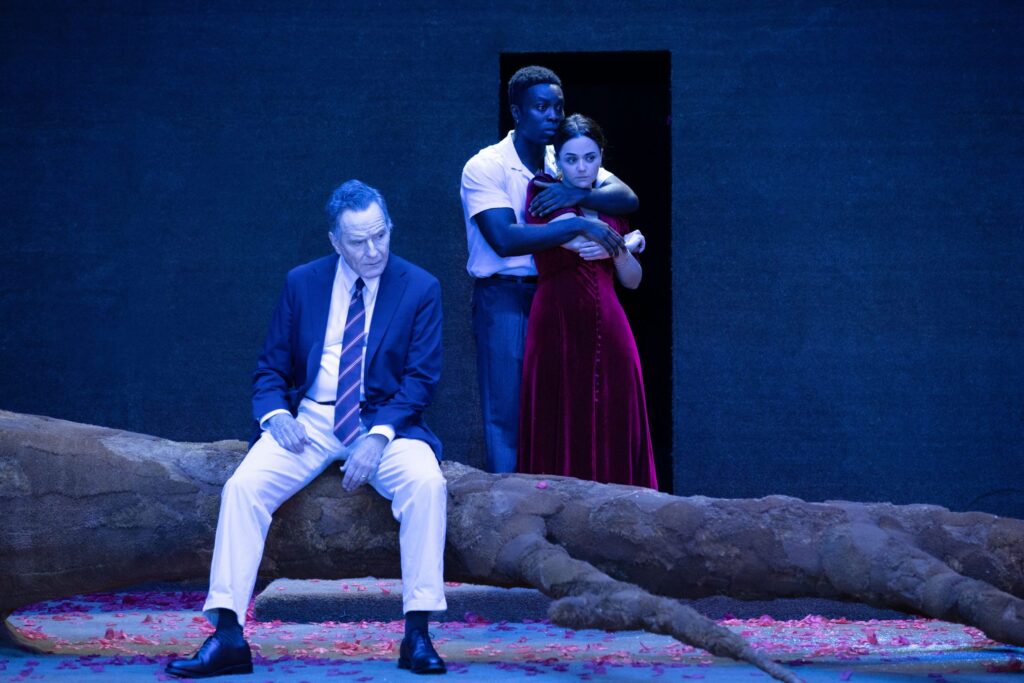
The play unfolds under a sun that becomes a moon that becomes a window, transformed from one to the next by astonishing lighting. The stage is stripped back and altar-like – sparse but not soulless. The fallen tree foreshadows the downfall to come. The opening scene says everything you need to know if you are not already acquainted with the story. From the outset you realise what the ending will bring.
This is the fourth of Miller’s plays that I have seen – all brilliantly written, heart-wrenching, subtle – and this one is a magnificent illustration of how people refuse to acknowledge the truth. Yet aspects of it felt a little off: would George really change his convictions and visit his father in prison just to tell him about an engagement that had not even taken place? Would Larry really kill himself on the basis of nothing more than press coverage? Would Ann really end a relationship after reading one letter from her dead fiancé’s meek brother?
I had to acknowledge that these are fairly minor flaws compared to the depth of exploration of a timeless topic, and I struggled to understand why they bothered me so much. Then I realised it was the portrayal of Chris that threw the production off balance.
In the early moments, not knowing the story, I thought Larry must have been the beloved son and Chris a simpleton, potentially with an intellectual disability, somehow stunted in his development. Paapa Essiedu’s character at the outset is so child-like, mumbling his lines under his breath, not at all the idealist in a hair shirt that Sue describes. When he wrings his arms in awkward ways whilst first kissing Ann, it is reminiscent of Snow White giving Dopey a kiss in the animated Disney classic. There is nothing righteous about him, nothing stand-up. He then escalates rapidly into shouting. When the façade crumbles, there is no depth of emotion – he is not a broken man no longer able to lie to himself and devastated by his mother’s involvement – he just shouts aggressively.
Let us not forget there is no moral high ground for him. He and his mother were complicit – not in the deaths of the twenty-one pilots, but in the destruction of Ann and George’s family. Kate knew full well; Chris suspected – and they let it happen. When Chris says to his father, “I thought you were better,” he is in fact saying it about himself too – his father is no saint, but he is no Jesus either. Essiedu’s delivery has none of this nuance; it is lost in all the yelling.
Cranston, on the other hand, is phenomenal and versatile; he portrays Keller in a manner that makes him so charming and so likeable. It is impossible not to fall in love with the kind grandfather figure to the kids from the area, the charm, the grin, the care he has for his wife. Early on you begin to suspect what actually happened – but you work hard to find ways to deny what you deep down know must be the case.
And then the truth finally comes out and this is no Grapes of Wrath – his family wouldn’t have starved, he was nothing more than a greedy bastard. Yet the denial continues, and you are still trying to find ways to exonerate him, searching for something good in him. When you realise that you are fighting to justify the unjustifiable, you know that Cranston and Miller have got you exactly where they wanted you. Which is why, when at the end Cranston says “they were all my sons” and you see him break and shatter into pieces as the words leave his mouth, you somehow end up feeling compassion for this dreadful villain and manage to put the twenty-one pilots and the Deevers out of your mind.
The trees around the Keller family’s house that enclose it from the world are like the wool we pull over our own eyes to create a reality we want to exist in. We find ways to bend the truth and when facts don’t align with what we want to believe, well, too bad for the facts. Denial is the best answer.
We tell ourselves our children are OK despite the hours clocking up on screens, that our relationships are just fine even when we have nothing left in common, that our job is secure despite the rise of AI. We choose filters to enhance our image, we curate a narrative on social media to present our life the way we wish it were, we choose our newspapers to show us the world as we want to see it, we refuse to see AI deepfakes for what they are when they align with our views, we let algorithms push us a feed that reflects events as we want to perceive them.
We all know we are in denial, and we deny realising that we all need to dedicate a little more time to figuring out exactly about what.