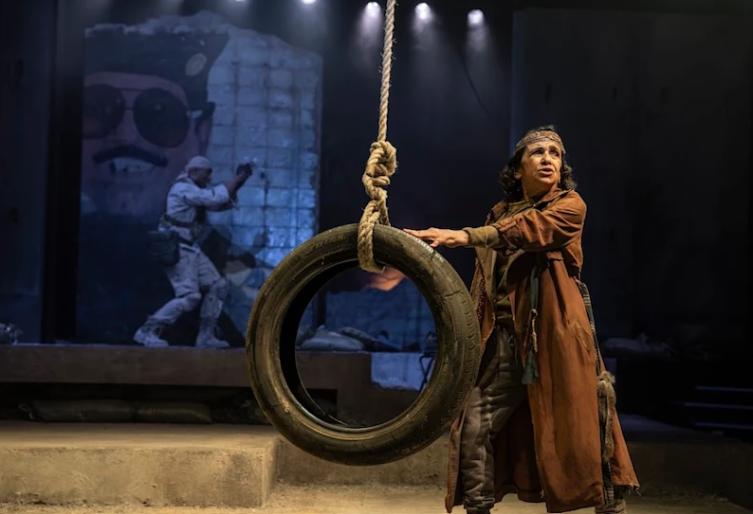
Set in the early days of the second Gulf War, and premiering before the withdrawal of U.S. troops from Iraq, this harrowing play charts the brutal acts taking place both before and during the American occupation from the vantage point of the ghost of an existential tiger. Suspended in purgatory, the tiger’s ghost walks the ruins of Baghdad, stepping between Hamlet and Aesop, between the living and the dead, between humans and animals, between the deranged and the almost sane, between the cultured and the sadistic tyrants. The tiger scorches the audience with philosophical analysis, searching for meaning in a post-apocalyptic reality where ghosts haunt the streets corroded away by power.
This premise alone is probably enough to leave most people breathless. But there is more. We were sitting next to three gentlemen, one of whom had seen the play nine times before. I was surprised to hear this – I have not seen my favourite Shakespeare anywhere close to that number of times – but as the play unfolded I began to understand why. The play packs so many themes into its 130 minutes that I quickly became overwhelmed, my mind not fully able to process everything. Already the following day I was struggling to remember all that had happened and thoughts were escaping my grasp.
Walking home, I felt intoxicated; my mind was spinning with everything that had been thrown at me: prostitution and child exploitation; greed and guilt; culture and identity; vegetarianism and post-war psychotic stress syndrome – all served up with a generous helping of the deranged and deplorable cruelty and sadism of the Saddam regime.
But mostly I was under the spell of Kathryn Hunter’s performance. I did not even notice that she was reading her lines, having just unexpectedly stepped into the role. Her performance was enthralling – the god-seeking tiger questioning why he had been created a predatory meat-eater if the expectation is that we should all be vegetarian. Against the backdrop of wartime destruction, the tiger confronts us with the question whether any of our actions can ever be a sin if god created us knowing full well how we would behave, endowing us with the propensity for unthinkable evil. “You knew I was a tiger when you made me, motherfucker!” she annunciates, pinning the blame on the Creator for all the carnage that had ensued.
Can we ever overcome our true nature? There are no answers in this play and potentially too many questions, but that is what true existentialism is about.