On 7 May 1964, The Guardian described Orton’s first play as a ‘milk-curdling essay in lower-middle-class nihilism’. A dark farce, it aimed to shock contemporary audiences with taboo subjects, including homosexuality. By the time the screen version appeared in 1970, sex between men over 21 had been legalised in England. Disdain lingered, but the silence had been shattered.
In 2025, that disdain has vanished too, but instead we are in the throes of wokeness and political correctness. Comedians face cancellation for jokes deemed ‘inappropriate’, whilst speech is policed by actual police with firearms. Could there be a more fertile moment to revive this once-scandalous four-hander about sexuality, violence and hypocrisy? So why does this production feel more like a 1960s period piece than a subversive, menacing take on shifting power dynamics, moral corruptions and carnal desires?
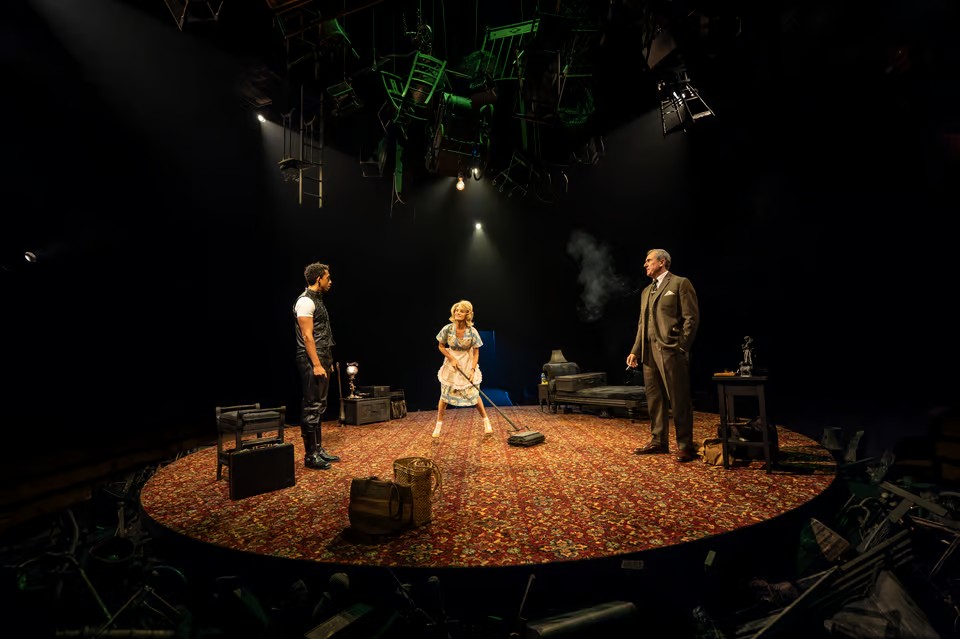
From the outset, the staging is unsettling. The action unfolds amid the detritus of a scrapyard, evoking an apocalyptic air. Rusty relics—a ladder, a pram—hang suspended in the gloom, rather like the Open Wound exhibition in Tate Modern’s Turbine Hall, as my theatre companions observed.
The dark and ominous feeling that this evoked set the tone. Not knowing the narrative that was about to unfold, it took me a while to feel that it was appropriate to laugh at the brazen misogyny and Oedipal lust. And believe me, there were vicious barbs, brilliant innuendos and lines that even today should remain savage and startling. But too many of them fell flat, most of the audience remained silent – no laughter, no gasps, no outrage. In the second act, the rhythm slackens and many moments rather than shock merely peter out.
I’m not entirely sure why, but I suspect it stems from Jordan Stephens’s unconvincing Sloane. He is not very good looking, he is not charming, he is not sexually alluring, he is not calculating, he is just underwhelming. He should be enigmatic and magnetic – a talented Mr Ripley figure of sorts – but here he emerges as faintly comical, his highlights limited to deft press-ups and superfluous strobe-lit dancing. Consequently, his actions feel contrived and motiveless, eroding credibility—especially once he dons leather, resembling a Village People extra.
This in turn weakens the siblings’ impulses, but even so, Tamzin Outhwaite’s Kath stands out as the most vivid and engaging presence. Her ditsy Stepford Wife persona transmutes into a depraved, predatory one from The Devil’s Advocate a flip of a switch. Sloane is both child and lover as he suckles at her nipple; toothless she goes down on him, asking to be called ‘mamma’.
Yet Outhwaite also conveys Kath’s profound damage and desperation: not merely a jaded housewife, but a woman warped by the trauma of losing her baby, enduring years of abuse and coercive control from her brother, of constant exploitation. She elicits pity and revulsion in equal measure.
But whilst Kath’s character strikes an interesting balance, the balance of the play overall just isn’t right; the equilibrium between laughter and dread is off-kilter. For the final climax to deliver the jolt necessary to flip the entire narrative upside down, the first half has to elicit laughter and the second needs a growing sense of terror. In this case, there simply was not enough momentum to make that happen.