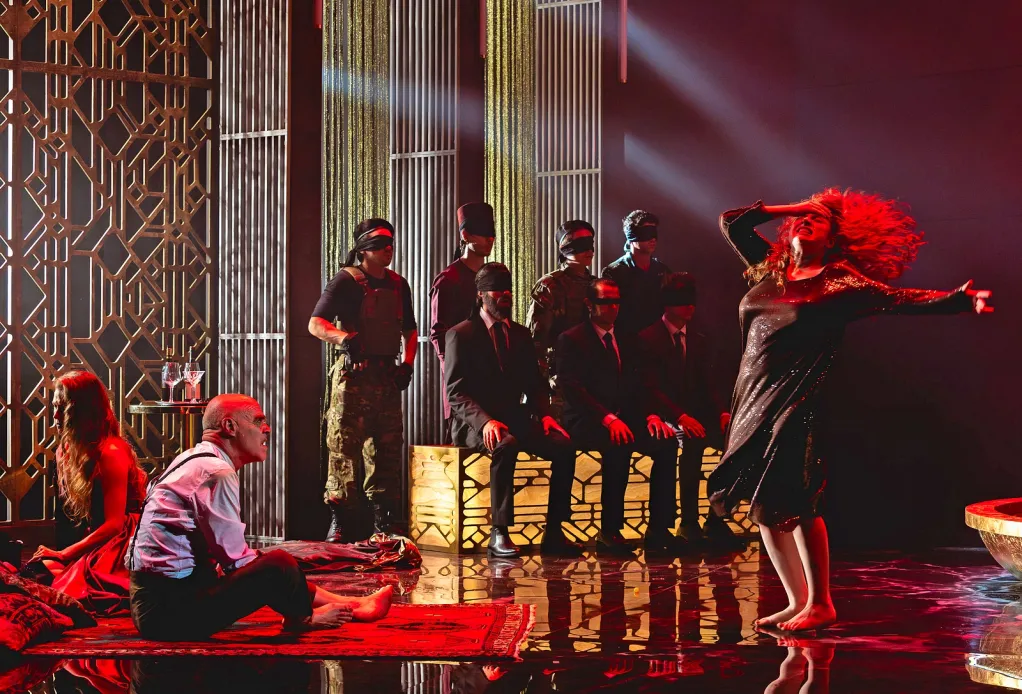
I have loved Oscar Wilde for as long as I can remember. I had a blue, hardback copy of his fairy tales that I read over and over as a child. I have adored his plays, and no matter how many times I go to the theatre, they never fail to make me laugh and wonder at his wit.
But I knew Salome was different. Wilde wrote this debut script in Paris, in French. It was translated into English by Lord Alfred Douglas. Unlike his other pieces, it is highly stylistic, symbolic and poetic. And for the most notorious scene, the stage direction says nothing more than, “Salome dances the dance of the seven veils.” On this basis, I have been adamant that this was a play I needed to experience on a stage, not on a page.
Originally, it was banned from the British Stage for forty years, officially due to its portrayal of biblical characters, but equally because of the sexually obscene elements, including incest and necrophilia. Audiences watching this somewhat illicit play in Paris in 1896 must have been shocked, and I was curious to see how one could achieve an equally visceral reaction in today’s jaded world. So I was very excited at the opportunity to see this Gesher Theatre production at Blavatnik’s West End venue.
It definitely had an impact on me. For substantial parts of it, I felt a little confused, often bewildered, but at the same time mesmerised. Something in Jokanaan’s (John the Baptist) very emotive and disturbing vocalisations – delivered from behind an intermittently opening wall panel and amid the general histrionics – was both fascinating and overwhelming at once. There was this strange quality to the production that made me feel as if I was watching a bizarre dream unfold, with a narrative that jumped around and deranged characters delivering lines that didn’t fully make sense in a way that seems disconnected from their meaning.
But are they truly disconnected? Take, for example, the completely flat and unconvincing protestations of the mother, pretending to be uncomfortable with her husband lusting after her daughter. She delivers objection after objection, but the manner in which she does it leaves no ambiguity. The hold the 14 year old has over Herod is to her advantage; it gives her the power over him that she needs, it keeps her relevant. All pretence falls away when her daughter’s act of shedding her clothes gets her what she was unable to achieve on her own. A parent using her child for her own goals; the daughter an ultimate accessory.
But what clinched the performance for me was Roth’s depiction of her character. She starts off as a precocious, spoilt teenager, using the sexual magnetism of her youth to get her way. However, it quickly becomes obvious that she struggles to handle her emotions – she is petulant, and she most certainly cannot deal with rejection.
She becomes obsessed with the imprisoned prophet and repeatedly attempts to seduce him. But her actions are highly performative; they are devoid of any sexuality; they feel like a reflection of what she may have seen of her mother but never fully understood and is now mirroring. What starts as pouting, with every iteration, transmutes into utter madness driven by his refusal. It is clear nobody had ever said no to her before, not a single person had ever disagreed. And her reaction is extreme.
When it comes to the infamous seven veils dance, it is not the dance of the temptress, it is not a seduction. She does not discard her veils for her stepfather’s pleasure, but rather tears them off in a frantic, aggressive tantrum. Watching the performance unfold, I was reminded of the crazed female activists hurling themselves at whatever cause du jour they had chosen that day. Ferociously yelling with angry sneers, demanding someone’s head on a cancellation platter for daring to disagree, daring to be defiant, daring to hold a differing opinion. They will not be satisfied until the object of their irrational desires rests in their lap, drenched in blood, no longer able to deny them.
This performance was not obvious, it was bizarre, but it was very intense and left me emotionally drained, unable to speak. These timeless stories continue to resonate, just on different frequencies.