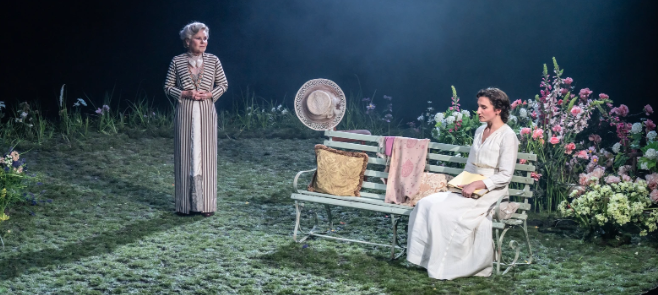
This performance felt strikingly contemporary. Whilst I thoroughly enjoyed Pygmalion at the Old Vic, its present-day relevance took a while for me to uncover. In this play, the dialogue seemed to reflect many aspects of the conversations I am having with my children right now. It cuts to the core of the rhetoric surrounding the idea of “privilege” which I personally find troubling because of its role in fueling existential guilt and creating a culture of victimhood-seeking.
And more directly, it resonates with present-day discussions about women’s rights – what is empowerment and what is exploitation, who is exploiting and who are the exploited, and last but not least, who has the authority to judge?
Surrogacy is at the heart of those debates today – many proclaim it enables women with limited options to earn substantial income whilst bringing profound joy to others; many view it as a perverted form of modern slavery, dangerous and degrading to the woman, deeply cruel and harmful to the baby. Stories about women on OnlyFans are also a major topic of conversation, viewed by some as a pinnacle of female empowerment, by others as a tragic consequence of a pornified culture, and by others still as exploiting those who pay for access
It is therefore not surprising that Mrs Warren’s lines felt as if they were straight out of a modern day anti-criminalisation pamphlet. But it is a shame that the director decided to introduce his own personal views on the matter. Over the course of the play, a chorus of Mrs Warren’s underwear-clad employees take apart the revolving garden set, leaving nothing but an empty room and single bouquet of flowers dumped in a waste basket. This measure is quite brilliant, but points the audience too strongly towards what Cooke considers the correct moral stance on the issue to be.
There is another angle to the play. For me, as a mother, it raises the question of how much about themselves should parents disclose to their children. Is full transparency the best policy, or actually is it right to hold some things back? It also asks when is the right time to disillusion children who look up to you and what rights do parents have over their children (and vice versa)?
The dialogue between the mother and daughter that ends the play does a brilliant job at illustrating what is a fairly common parent-child dynamic. Parents, honest about their motivations, are selfish in their pursuit of the best outcomes for their children, never thinking twice about crossing the line. The holier-than-thou children endlessly critical and moralising towards their parents are unable to accept that the better choices they have in life have been afforded to them by those very parents.
It is a superb dialogue, even if a little preachy at times, which is why I do not understand the decision not to have an interval. The play lasted almost two hours; the first two scenes were significantly more light-hearted than those that followed. There was absolutely a natural place to give the audience a break and to have us come back, with reignited attention, ready for the ending. I did feel my ability to concentrate wane by the end and therefore feel that I did not fully engage with the ending.
In addition, I am not convinced with the choices of actors. It is fascinating that in this play, written by a man in the years that it was, two women are at the heart of the constellation, with men but orbiting planets, poorly written and pretty much redundant. Those women in this staging are actual mother and daughter, but Bessie Carter is circa 10 years older than Vivie who she portrays. This significantly impacts on the how we perceive the character and some of her actions. What could make sense with the naivete of age, falls a bit flat from a 31-year-old who should be capable of a bit more nuance. The confusion is amplified by the character of Mr Praed. Whilst Shaw provides no precise age, it would be reasonable to estimate him at approximately 40–50 years old whereas, Sid Sagar is in fact Carter’s contemporary. Maybe if his acting was not as appalling wooden, he could have gotten away with it. But we are left with a grown-up woman pretending to be straight out of university, lectured by a man her age, pretending to have the wisdoms of someone significantly older. There is something so patronising and not credible in this dynamic, that it throws the first half of the performance off balance.
These flaws are unfortunate, but they don’t diminish the brilliant performance by Imelda Staunton. She lets Mrs. Warren’s polished, high-society dialect slip ever so slightly into a Cockney edge whenever her composure falters; she allows the mother’s pride and love to break through her professional mask with adoring glances cast at her daughter; and in mere seconds, she conveys the raw anger and despair of a parent rejected by her child. We know Cooke grants Vivie the moral high ground, but my empathy rests elsewhere.