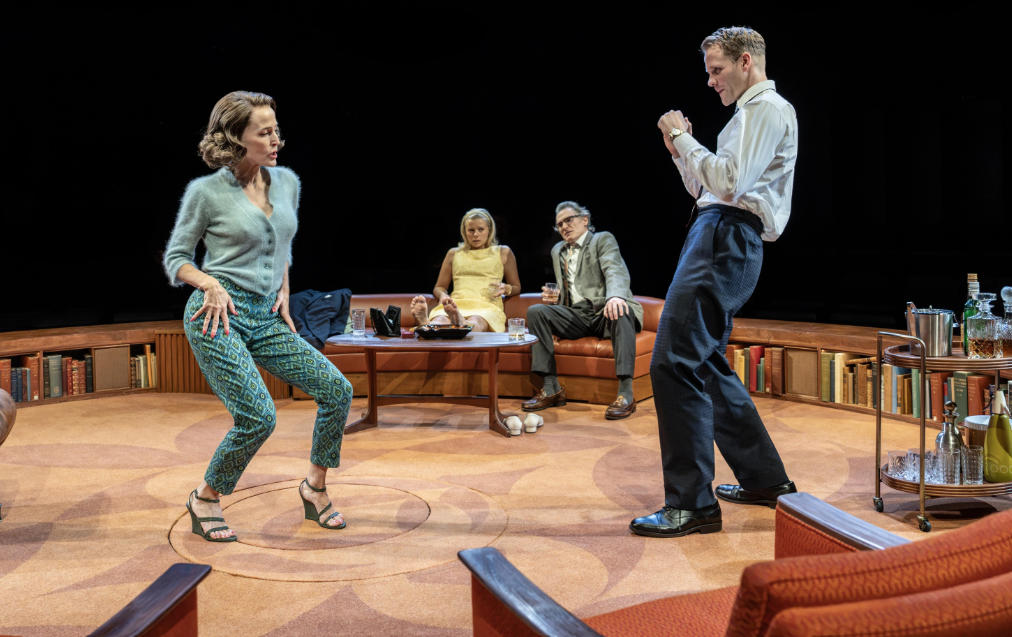
On the way home from Who’s Afraid of Virginia Woolf?, we unexpectedly bumped into some friends who guessed that we were coming back from the theatre. One of them asked whether Anderson and Crudup were exceptional. The play itself, she said, was so well known and had been so extensively analysed that there was probably little left to discuss.
To her chagrin (she had decided not to invest in tickets when they first went on sale, and none are available now, although batches continue to be released), I confirmed that Anderson and Crudup were exceptional, both individually and together, and worth the extortionate price.
For me Crudup was the stronger of the two. I had seen him in High Noon, where he impressed me far more than the play itself, so I took particular pleasure in seeing him at such close quarters performing a brilliant script. From my seat, I could catch the smallest changes in his expression, including moments when it felt as though he was rolling his eyes directly at me.
Anderson and Crudup brilliantly sustain the uncertainties for which the play is famous: what is real and what is pretend, who is manipulating whom, where victim ends and perpetrator begins. Martha’s emasculation of George is brutal, but does the humiliation turn him on, or merely whet his appetite for his own attack? The balance of power never stays still for long.
These games are the shape their intimacy has taken. Their love has morphed into something outside the pages of the Romantics. The tenderness has not fully gone, but the need to elicit a response from the person who knows you best, and is also most capable of making you feel invisible, has taken over. The precision with which they provoke and hurt reveals how deeply they know and, in fact, need each other.
Those themes have long formed part of the interpretation of Who’s Afraid of Virginia Woolf?. But I think my friend was wrong about there being little left to discuss. Great plays continue to reveal themselves differently as the context in which we encounter them evolves.
Take misogyny as an example. I found Some Woman flawed because its perspective was limited to that of a woman being diminished, disregarded and wronged by men. Those experiences are real, but they are only part of the picture, and as a society we seem to be forgetting that. Who’s Afraid of Virginia Woolf? reminds us that women can also be perpetrators. Martha knows George’s weaknesses and exploits them ruthlessly, humiliating and belittling him, often in front of others. She uses words as violence. And she is very well versed.
But our assessment of that behaviour also has to allow for the hold Martha’s father continues to exert over her. In Ferdydurke, Gombrowicz invented the word upupiony: the state of being reduced by someone else to a smaller, more childish version of yourself. Its absurd premise, a thirty-year-old man forced back to school, becomes an exploration of how another person can trap you in an identity you did not choose.
Martha has been upupiona by her father. She has grown up without ever entirely growing beyond the identity he created for her, still seeking Daddy’s approval while trying to tear down the man she married. Honey is upupiona too, but differently; cocooned by the money inherited from her father, she remains the perpetual girl. Both have had their adulthood arrested. An interesting realisation at a time when what it means to arrest a child’s development through puberty blockers is itself being debated, alongside the Conversion Practices Bill.
Childlessness is another contemporary lens. Marriage is supposedly the most exclusive of relationships, two people choosing each other above everyone else, but exclusivity rarely means that nobody else is involved in the shared life they create. Children, when they are part of it, provide an almost inexhaustible common subject: their problems, successes, failures, needs and futures. They also reinforce the couple’s connection through the love they share for their child.
George and Martha have none of that. At a time of falling birth rates, parenthood deferred until later in life and declining fertility, childlessness is becoming part of the reality of more relationships. George and Martha conjure up a son and, with him, a shared history and another bond between them. Perhaps soon most couples will be inventing imaginary children to populate the space they might otherwise have occupied.
Martha’s determination to bring the younger couple home feels connected to the same need. Their son gives George and Martha someone else to talk about; Nick and Honey give them someone else to talk to, perform for, provoke and fight over. Other people, real or otherwise, become part of the marriage.
And so does the audience through the in-the-round @sohoplace staging. Miriam Buether’s high-end mid-century living room gave me serious house envy. I want that drinks trolley! But more importantly, the in-the-round staging means there is always more than one performance to watch. Josh Dylan and Phoebe Horn are brilliant in their own right, and there is real pleasure in watching Nick or Honey even when Anderson and Crudup are in the action. The stage revolving slowly, constantly changes your perspective and allows you to observe everyone from different angles, just as George and Martha observe the people they bring into their home.
It seems that, in the same way Nick experiments with chromosomes, George and Martha conduct their own kind of experiment on their guests. And sitting so close to the stage, I began to feel a little like a scientist myself. Which is perhaps why, despite being fascinated throughout, I remained oddly detached. For the most part, I was emotionally unaffected.
Or perhaps there is another explanation. By the end, I was convinced that this was not an unusual night in George and Martha’s marriage. Once they have sobered up and rested, there will surely be another couple among the new faculty joiners for George and Martha to invite home and play with. So you cannot really take it all to heart. After all, it’s just tonight’s performance.
Leave a Reply