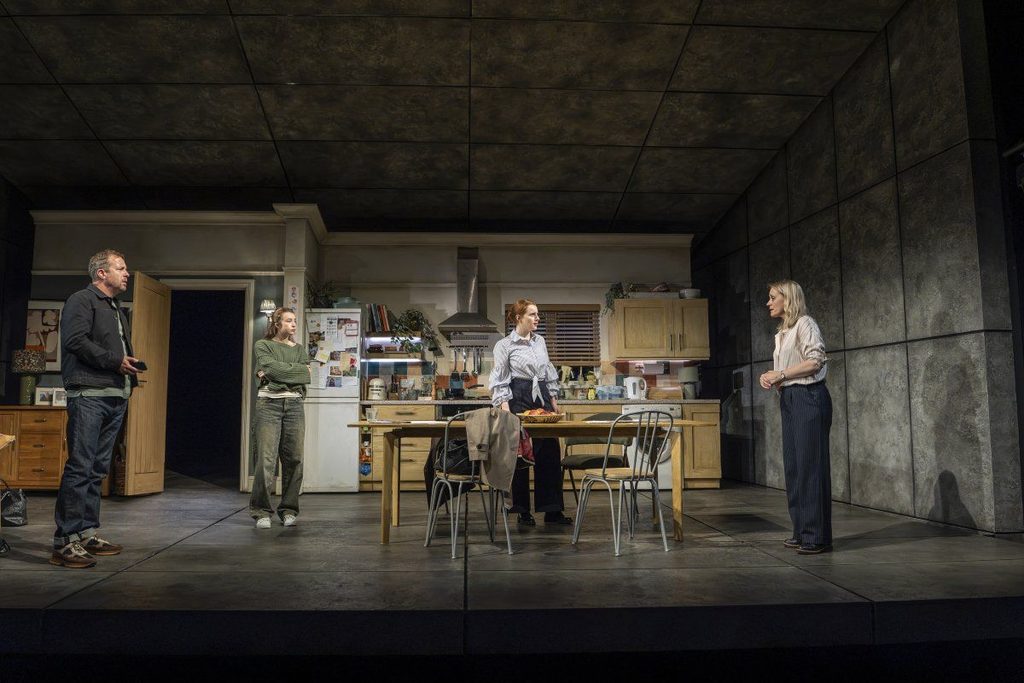
There can be few women of my age who sit through Some Woman without recognising something that has happened to us, to someone we know, or something we fear may happen yet. A life built around other people; children who grow up and judge the choices you made for them; being talked over, disregarded or told what to do. And, somewhere underneath it all, the possibility that after a lifetime of being surrounded by people, you might end up terribly alone.
Despite this recognition, the play felt to me like a broken kaleidoscope: sharp, familiar pieces scattered across the stage, fundamentally flawed because they fail to fit together. A performance of somewhat stereotypical characters without a coherent story.
Anne-Marie Duff makes Julie herself entirely believable. She is exhausted before the play has really begun, worried about her younger daughter, trying to sell the family home after divorce, dealing with problems at work and navigating a difficult relationship with her older daughter, who is about to move abroad. Everyone around her tells her what she should do; her views are dismissed or overridden; she absorbs everybody else’s needs and opinions while becoming increasingly unsure of her own. Permanently anxious and downtrodden, “sorry” feels like the word she uses most often.
But what struck me most was her loneliness. At one point she is asked whether she has discussed what is happening to her with her friends; what friends? I found myself wondering. After a husband, children, a home and a working life spent caring for and accommodating other people, when something goes badly wrong she is essentially on her own.
The staging reinforces this. The cluttered family home represents both the life Julie has built and what she is now losing, while the cold walls of the institutional world outside close in on her as her situation deteriorates.
That situation, however, is simply not credible. I understand the idea of the final straw: a woman who has spent a lifetime being the punching bag decides that this time she won’t just take it. But with everything Julie already has going on, I didn’t believe that an encounter with an abusive 11-year-old would be the battle she chose to fight.
The legal escalation that follows is harder still to believe, particularly the advice Julie receives. In Kafka’s The Trial, the nightmare lies in not knowing why the protagonist is being prosecuted. Here we know why, and it simply makes no sense. There are enough real examples of the law failing women without inventing one so difficult to believe.
In addition, the play introduces too much material without giving enough of it the space to develop. Julie’s childhood sexual abuse is tragic, but feels thrown in for good measure, while Ginny’s eating disorder and wider mental-health problems are too prominent to be incidental, yet completely unexplored. At times it feels as though Helen Edmundson has gathered every story and issue she has ever encountered about misogyny and the ways women are diminished or abused, and desperately tried to find a way to include them in her writing.
There is also Nathan, Julie’s son-in-law, whose job problems and flashy new car appear to lead nowhere. I rather enjoyed Nathan himself. He is so different from almost everyone else around Julie that he acts as something of a palate cleanser. But even there I found myself wondering what drew Kate to him and are they credible as a couple.
Most notably, I wanted to understand more about Julie and her older daughter. Kate’s memories suggest anger, shouting and volatility, while Julie seems bewildered by that version of herself. Was Julie sometimes aggressive? Did those pressures make her lash out at her children? Is her understanding of herself as the person who endlessly accommodated everybody else incomplete? Or is Kate remembering the ordinary failures, rows and frustrations of childhood as something more? Had the play explored that ambiguity further, we might even have begun to question Julie’s own account of the incident on the platform. Perhaps she did do something to the boy? That uncertainty might have made Julie less one dimensional and the story itself more plausible.
There is, however, one scene in which none of this matters. Julie is confronted by the boy’s father and, while I didn’t find the circumstances that brought them together any more convincing than much of what preceded them, the scene itself is extraordinarily powerful.
Stephen Wight barely needs to do anything because the menace lies in what he might do. Duff conveys something horribly familiar: the calculation a woman makes when confronted by an angry man, and the awareness that any man, even an adolescent son, is physically capable of hurting us if he chooses to. There is no physical violence, but there is plenty of another kind: the intimidation, the threat and the fear of what could happen next. I felt myself tense up. I was scared watching.
But sorry, even that cannot redeem the play. I left the theatre not unsettled by what I had seen, but by mentally listing everything that did not fit together.
Leave a Reply