I have always been of the opinion that not everything needs to be turned into a play, let alone a musical, and at first glance The Standard of Living could easily have fallen into this trap.
John Maynard Keynes’s story is fascinating, but it sprawls across decades, relationships, wars and political arguments: from the aftermath of the First World War and the Treaty of Versailles to the reshaping of the international economic order after the Second. Along the way there is the Treasury, the Bloomsbury Group, his seemingly unlikely marriage to Russian ballerina Lydia Lopokova after years of sexual encounters with men, his battles over economic orthodoxy and eventually his role in creating institutions that continue to shape our world. Film would seem the natural medium for a story with that kind of sweep, particularly when the material relies more on ideas and events than on the sort of heightened emotion that demands extraordinary acting to make it work.
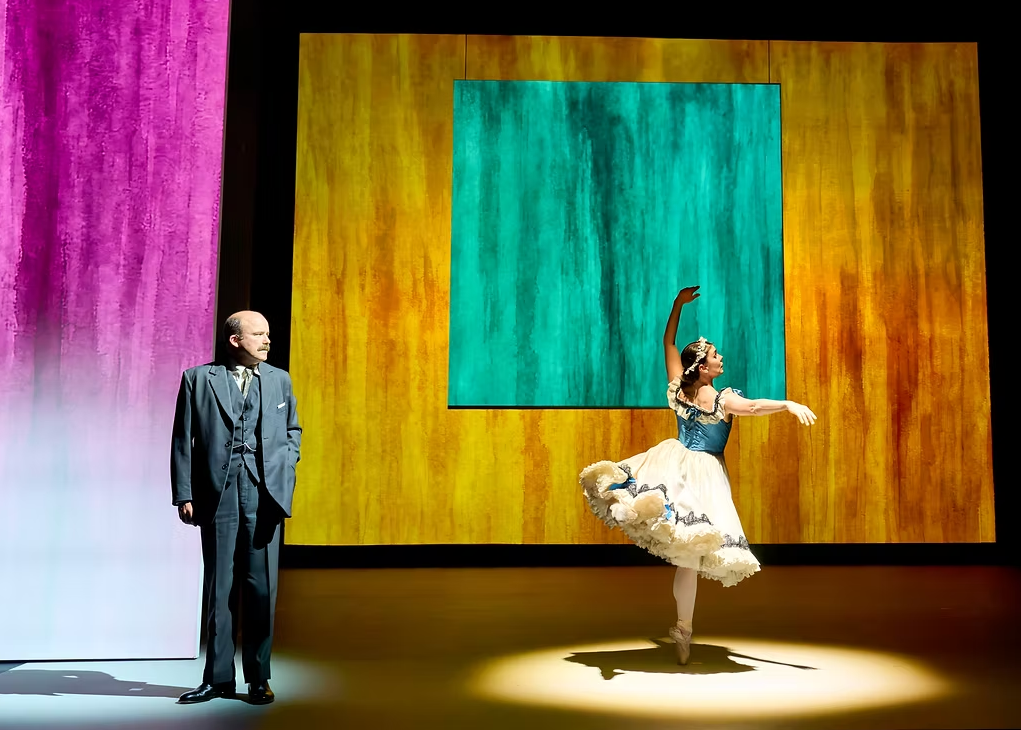
What makes The Standard of Living work as theatre, however, is the production itself. The sliding panels give the stage something of cinema’s freedom, allowing decades, places and events to pass in quick succession without the production ever feeling static. More importantly, they allow colour, art and beauty to impose themselves on the stage, transforming spaces that moments earlier felt austere and functional into something vivid and full of feeling. Images and artworks appear and disappear, while choreography and dance spill into the action. The effect is not simply visual: the production gives physical and emotional form to the idea that art and life are intertwined. Art is not presented as some pleasant extra to be enjoyed once the serious business of economics and politics is finished, but as part of what makes a life worth living. Dance is part of the storytelling rather than an embellishment. The production illustrates how Keynes inhabited both the grey world of economics and the colourful world of art, letting one continually break into and transform the other. This is particularly effective when one of the confrontations between Keynes and Friedrich Hayek is transformed through dance into something physical rather than merely theoretical.
Keynes moves between Whitehall and Bloomsbury, between trying to persuade governments to think differently about economies and spending his time with artists who think rather differently about almost everything. In some ways, he is both an insider and an outsider in both worlds. There is also a certain irony in watching the Bloomsbury circle look down on the compromises of his public life while Keynes helps to fund the artistic existence that allows them such freedom. That irony becomes funnier still in their rather grand dismissal of Lydia. They turn their noses up at the ballerina, while she sees them as cats that have grown fat and comfortable, insulated from the struggle and pain they believe gives art its meaning. The outsider, in other words, may have a sharper understanding of what it actually costs to be an artist.
And it works because the argument is never really just about competing economic models. Behind those arguments sits the much bigger question the play keeps returning to: what is an economy actually for? What makes a good life, and what, if anything, should government do to help create the conditions for one? Financial security matters, but so too do art and beauty, friendships, love and relationships.
The history also has an unmistakable contemporary resonance. First, by taking Keynes’s story through the end of the Second World War and into the construction of the post-war economic settlement, the play reminds us how Britain’s modern relationship with the United States came to be what it is. Second, it is hard not to think about the pendulum of politics and our tendency to allow a necessary correction to one orthodoxy to swing so far that, eventually, it creates another. The argument over how much the state should intervene, spend and invest, and how much should be left to markets, hardly feels settled or historical. The play sets Keynes’s advocacy of government intervention against Hayek’s competing ideas, which would find renewed political influence decades later. Watching that debate play out with the benefit of hindsight inevitably leaves you wondering where the political pendulum has brought us now, which way it is moving, and how far it will travel this time.
The Standard of Living did not grip me emotionally, despite very good performances, particularly from Rory Kinnear as Keynes and Natalia Osipova as Lydia. But that did not really matter. I left fascinated by the story and by how beautifully and imaginatively it had been brought to the stage.
Leave a Reply