I had a bit of a moral dilemma about whether to write this review at all. In fact, on the way back from the theatre, I had concluded that I would do no more than a short paragraph, more as a reminder to myself than anything else.
This is clearly not just another major London production. Mark Rylance has attached himself to a project that is, at least in part, about creating opportunities for recent Intermission Youth Theatre graduates to gain experience on a major stage. That is a commendable ambition, and I have no desire to criticise efforts to open doors for people at the beginning of their careers.
But by the time I woke up the following morning, my disappointment had not dissipated. If anything, it had intensified. Frankly, I realised that I felt completely Tartuffed.
Because while I can admire them, I do not think good intentions place a production beyond criticism. I do not buy full-price theatre tickets to participate in someone else’s social-impact endeavour. I buy them to spend an enjoyable Friday evening after a very hard week’s work. It is my reward to myself, my way to unwind, my way to reset.
So I do not find it acceptable to advertise a production without adequately warning people what they are actually signing up for. This statement is now available on the website. Whether it was made clear when we bought our tickets, the moment they were released, I cannot say:
“The cast and crew of Tartuffe (Remixed) are delighted to welcome ten fantastic recent graduates from Intermission Youth Theatre’s training programmes to join the company as the Ensemble. Two performers will feature in each performance of Tartuffe (Remixed) on rotation.”
Knowing this might not necessarily have changed my decision to attend, but at least I would have been better prepared for the quality of what was in store.
At first, I wondered whether we were seeing a preview production. Matters were not helped by the fact that we had a stand-in for Elmire. It seems unfair to criticise her, given that she had been called in earlier that day, although having seen Kathryn Hunter do exactly that in Bengal Tiger, I know what a truly great actress is capable of under such circumstances.
But no. We attended on 2 October, and the production had been running since the 4th of the previous month. Yet the overall effect was that of a low-quality school play where the teacher had not quite explained blocking to the students. The largely mediocre performances did little to dispel that impression. Characters drifted around the stage without much purpose, while comic timing, so critical to a good comedy, was repeatedly missed.
Then there was the issue of line delivery. I generally struggle with accents, so a combination of Nigerian, Jamaican and Estuary English was always likely to be challenging. But the constant swallowing of lines, the inability of half the cast to enunciate clearly, or even to make the meaning of the lines apparent, hardly helped. Nor did the constant shouting. Because the emotional register was one-dimensional. Every feeling was permanently turned up to maximum, which eventually meant that none of the emotions registered at all. They simply became noise delivered at high volume. There was no nuance whatsoever.
By the end of the first half, I was already exhausted and underwhelmed by how much the story had been stretched out. It deteriorated further in the second half, with the humour relying increasingly on crude, base jokes. Because unfortunately, and as is so often the case, the plot modernisation does not hold up under scrutiny.
Perhaps what Darren Raymond does with Shakespeare for Intermission Youth works within that context. But here it is not intellectually robust enough to sustain itself. The contradictions and plot issues created by relocating the play to a Nigerian-Jamaican household in modern England are countless. Far too many to list.
In addition, the attempts to introduce a racial justice narrative also fail. They may have elicited approving laughter from parts of the audience, but the logic collapses under even slight examination. Whatever the race of the characters involved, someone who deliberately takes a rifle and guns down another person should expect to go to prison. It is not acceptable to execute a con artist who poses no threat to the safety, let alone the lives, of others. Yet the production seemed to expect the audience to celebrate this alternative outcome as some form of moral triumph.
The plot holes were compounded by what I can only describe as cringe-inducing rhymes. The script was neither particularly sharp nor especially witty. There were occasional flashes of clever wordplay, such as “What will Adanna do with this shrivelled banana?” and a joke involving David Attenborough, but these moments were few and far between. Nothing close to the quality of the original.
I am actually a huge fan of Molière’s rhyming couplets. In comedy, they can lend dialogue a natural lightness and sense of playfulness. That is, of course, assuming a strong translation or adaptation. Here, the rewrite felt heavy-handed. The rhymes were predominantly juvenile and often strained, but what little wit they possessed was further undermined by the cast’s delivery. Many landed without rhythm, precision or confidence. Comedy depends on exactness, and when a rhyme does not quite land, the meaning is lost and there is no laughter. If anyone has ever wondered whether there is a relationship between delivering rap and delivering rhyming couplets, this performance may help settle the debate.
Was there anything noteworthy about the performance?
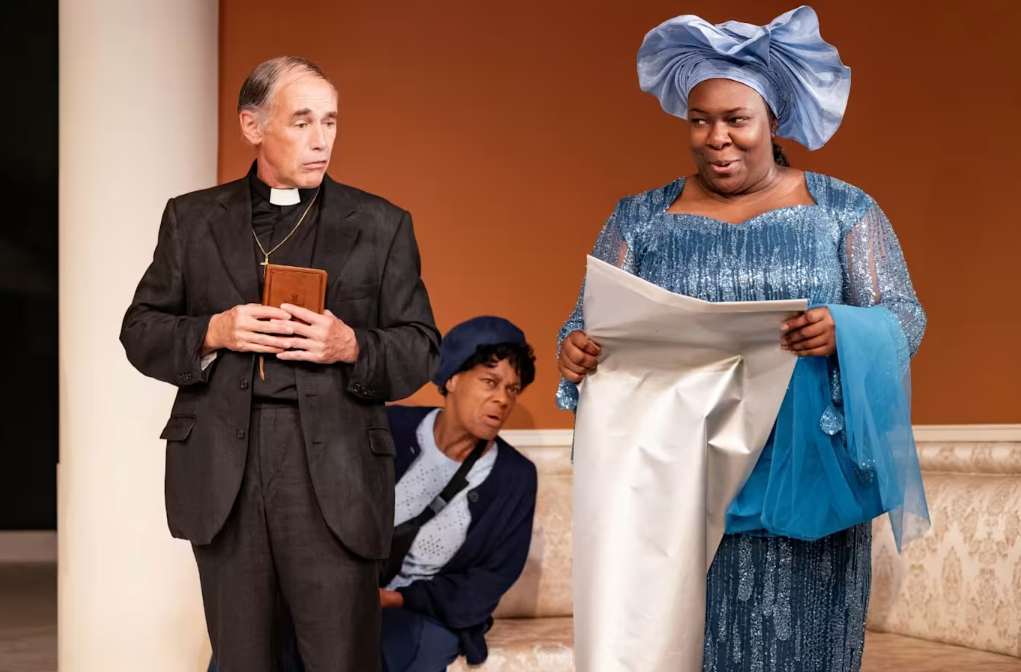
Well, there was Rylance, playing Tartuffe in a sort of vaudeville style, complete with false teeth and a comb-over that made him resemble a sinister ventriloquist’s dummy. His brilliant acting and impeccable timing only served to expose the weaknesses elsewhere. Rylance is such an established and confident actor that the difference was painful to perceive. The production had no momentum when he was not on stage.
I did, however, think that Morenike Onajobi, playing Kemi, demonstrated genuine potential. Her performance was inconsistent, and she did not always maintain her character convincingly, but she also had moments of real excellence.
I also liked the lavish house décor and the costumes, which I hope offered a reasonably authentic glimpse into the culture the production was drawing upon. The vibrancy of the colours was genuinely mesmerising. That said, the movement of the set often felt clunky, and I was not always clear why certain pieces of furniture needed to appear at all. Enter chaise longue, stage left.
But the few positives were not enough to justify 2.5 hours lost on a Friday night or the money spent.
Leave a Reply